
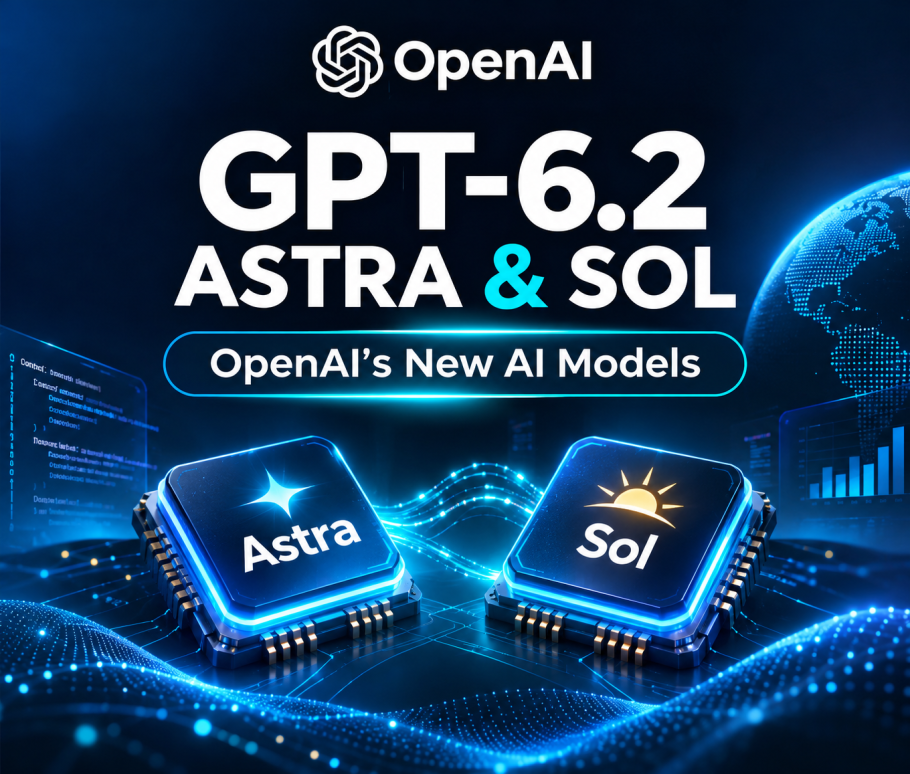
OpenAI has introduced GPT-6.2 Astra and GPT-6.2 Sol, two upgraded artificial intelligence models designed for professional work, software development and everyday tasks. Announced on November 17, 2026, the new models focus on delivering better results while using fewer tokens and reducing the cost of completing complex tasks.
The launch brings improvements in coding, document creation, spreadsheets, presentations, scientific research and AI-powered workflows. It also gives users two different options depending on the complexity of their work.
GPT-6.2 Astra is designed for demanding professional projects that require deeper reasoning and accuracy. GPT-6.2 Sol focuses on everyday productivity, coding and multi-step AI agent tasks at a lower cost.
But what has changed compared with the previous GPT-6 generation? And which model should developers and businesses choose?
What Are GPT-6.2 Astra and Sol?
GPT-6.2 Astra and Sol are the latest additions to OpenAI’s GPT-6 model family.
Rather than offering one model for every type of task, OpenAI is providing two models with different strengths.
GPT-6.2 Astra: Built for Complex Professional Work
GPT-6.2 Astra is OpenAI’s flagship model for demanding projects. It is designed to handle tasks that require deeper reasoning, detailed analysis and high-quality outputs.
Some of its main applications include:
- Creating professional presentations and business documents.
- Building complex financial spreadsheets and valuation models.
- Writing, reviewing and debugging software.
- Conducting legal and scientific research.
- Building websites, interactive applications and 3D designs.
- Completing long-running AI agent workflows.
OpenAI says Astra produces more polished slides, spreadsheets and documents that better follow professional standards and user-provided templates.
It also improves how the model handles existing codebases, including making focused changes, writing cleaner code and testing its work.
GPT-6.2 Sol: Designed for Everyday Productivity
GPT-6.2 Sol is the more efficient model in the new release. It is designed for everyday professional and technical tasks where users want strong results without paying for the most capable model.
Its capabilities include:
- Writing, editing and summarising content.
- Coding and debugging applications.
- Research and information analysis.
- Working with documents and images.
- Using tools to complete multi-step tasks.
- Supporting AI agents at scale.
OpenAI describes Sol as its preferred model for everyday work. The company says many of its employees use it as their default model for both technical and non-technical tasks.
One important improvement is its coding performance. On Cognition’s FrontierCode 2.0 evaluation, GPT-6.2 Sol comes within 0.5 points of GPT-6.2 Astra at approximately one-fifth of the cost when both are tested at their maximum settings.
GPT-6.2 Astra vs GPT-6.2 Sol: What’s the Difference?
Although both models belong to the same generation, they are designed for different workloads.
| Feature | GPT-6.2 Astra | GPT-6.2 Sol |
|---|---|---|
| Main purpose | Complex professional work | Everyday productivity |
| Reasoning | Advanced, deeper reasoning | Efficient reasoning |
| Coding | Complex software development | Everyday and advanced coding |
| Documents | High-quality professional outputs | Writing and editing |
| AI agents | Complex, long-running workflows | Fast multi-step workflows |
| Best suited for | Researchers, professionals and complex projects | Developers, businesses and everyday users |
| API input price | $8 per million tokens | $2 per million tokens |
| API output price | $40 per million tokens | $10 per million tokens |
In simple terms, Astra is designed for tasks where quality and reasoning depth are the main priorities. Sol is a more affordable option for tasks that need to be completed frequently and efficiently.
How Much Better Are the New Models?
OpenAI has reported improvements across several internal and third-party evaluations.
1. Better Performance on Professional Tasks
On Agents’ Last Exam, an evaluation of multi-step professional work, GPT-6.2 Astra scores 5.2 points higher than GPT-6 Astra. OpenAI also reports that it achieves this result at less than one-third of the cost per task.
The model also scores 5.5 points higher than Claude Fable 5.2 on the same evaluation, at around 5% of the cost per task, according to OpenAI’s published comparison.
These results suggest that Astra can complete demanding professional workflows more efficiently.
2. Improved Coding Capabilities
Coding is another major focus of the GPT-6.2 release.
GPT-6.2 Astra is better at implementing and testing complex changes in existing software projects. It can work through codebases, identify problems and make more focused changes.
Sol also delivers strong results. Its performance on FrontierCode 2.0 comes close to Astra while costing about one-fifth as much at maximum settings.
For developers, this could make Sol an attractive option for regular coding tasks, while Astra is better suited to complex projects that need more advanced reasoning.
3. Stronger Scientific Research Capabilities
OpenAI also highlights improvements in scientific research.
GPT-6.2 Astra sets a new high on Terminal-Bench-Science 0.1, which evaluates how well models can carry out scientific work using terminal-based tools.
It also achieves a new high on the Vals Science Index, an evaluation that tests how models interpret biological data and conduct experiments in simulated environments.
OpenAI reports that Astra scores nine percentage points higher than GPT-6 Astra on Terminal-Bench-Science while costing less than one-third as much per task.
4. Better Presentations and Business Documents
A major improvement is the quality of professional outputs.
GPT-6.2 Astra can create presentations that better match existing templates, including layouts, colours, typography and writing styles. It also produces more focused documents with fewer generic statements.
This could be useful for professionals working in finance, consulting, law, sales and marketing.
The goal is to reduce the amount of editing required after an AI model generates a document or presentation.
GPT-6.2 Pricing: How Much Does It Cost?
OpenAI has reduced the API pricing of GPT-6.2 Astra compared with GPT-6 Astra. GPT-6.2 Sol retains the same token pricing as GPT-6.1 Sol.
The published API pricing is:
| Model | Input per 1M tokens | Output per 1M tokens |
|---|---|---|
| GPT-6.2 Astra | $8 | $40 |
| GPT-6.2 Sol | $2 | $10 |
Astra’s input and output prices are 20% lower than those of GPT-6 Astra. Cached input is priced at $0.40 per million tokens.
Sol is considerably cheaper, with input pricing at one-quarter of Astra’s standard rate.
For businesses using AI through APIs, the difference can become significant when processing large volumes of requests. Choosing the right model for each task could help reduce operating costs without sacrificing too much performance.
New Safety Measures and Cybersecurity Capabilities
The new models also bring stronger cybersecurity capabilities.
OpenAI says both GPT-6.2 Astra and Sol are more capable of identifying software vulnerabilities, developing working exploits from known vulnerabilities and producing security patches.
However, these improvements also introduce risks. More capable AI systems could potentially be misused to support cyberattacks.
OpenAI has therefore introduced tighter safeguards for higher-risk cybersecurity requests. Some legitimate security research activities may also face additional restrictions or require special approval.
Another important detail is GPT-6.2 Astra’s AI self-improvement capability. OpenAI says Astra is its first externally released model to meet the High threshold for AI self-improvement under its Preparedness Framework. Sol remains below that threshold.
This does not mean Astra can independently build a more advanced version of itself. It means OpenAI’s evaluations indicate that the model can significantly assist AI research and development, creating both opportunities and safety challenges.
Where Can You Access GPT-6.2 Astra and Sol?
OpenAI is making the new models available through its professional products and developer platforms.
Users can access them through:
- ChatGPT Work: For professional tasks and complex workflows.
- Codex: For software development and coding tasks.
- OpenAI API: For developers building AI-powered applications.
- Business and enterprise services: For organisations integrating AI into their operations.
The models are available in ChatGPT Work and Codex for eligible Plus, Pro, Enterprise and Edu users. Developers can also access them through the API using the model identifiers gpt-6.2-astra and gpt-6.2-sol.
Availability and usage limits depend on the subscription and platform.
Which GPT-6.2 Model Should You Choose?
The right choice depends on what you need AI to do.
Choose GPT-6.2 Astra if:
- You work with complex software projects.
- You need detailed research and analysis.
- You create professional presentations and financial documents.
- You handle long-running tasks that require deeper reasoning.
- Accuracy and output quality matter more than the lowest API cost.
Choose GPT-6.2 Sol if:
- You need an everyday AI assistant.
- You regularly write, edit and summarise content.
- You want to automate common business tasks.
- You need coding support at a lower cost.
- You are building AI agents that handle frequent requests.
For many businesses, using both models could be the most practical approach. Sol can handle routine tasks, while Astra can take over when a project requires more advanced reasoning.
Final Thoughts: Is GPT-6.2 a Major Upgrade?
The launch of GPT-6.2 Astra and Sol is an important step in OpenAI’s move towards more capable and cost-efficient AI systems.
Astra focuses on improving complex professional work, scientific research, coding and high-quality document creation. Sol brings strong performance to everyday tasks and multi-step AI workflows at a lower price.
The biggest takeaway is not just that the new models are more capable. It is that OpenAI is trying to make advanced AI work more affordable and practical for businesses and developers.
As AI agents become more widely used, the ability to complete tasks reliably, use tools effectively and control operating costs will become increasingly important.
GPT-6.2 Astra and Sol show how the next generation of AI models is moving beyond simple conversations towards systems that can deliver complete, useful work.

- OpenAI Launches GPT-6.2 Astra and Sol: What’s New and How Do They Compare? - November 18, 2026
- OpenAI Reveals How It Monitors Misbehaving AI Models - October 30, 2026
- Meta Reaches the AI Frontier With Muse Wonder: Zuckerberg’s Big Comeback - October 15, 2026


