
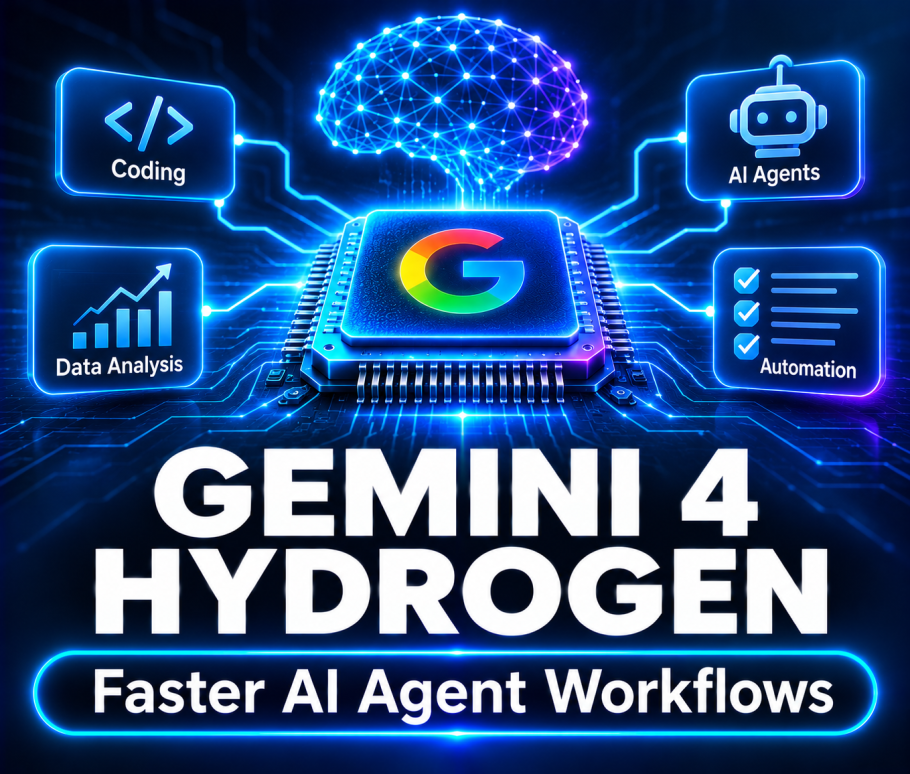
Google has introduced Gemini 4 Hydrogen, a new artificial intelligence model designed to handle everyday coding and complex multi-step tasks with greater speed and efficiency. Announced on November 12, 2026, the model focuses on agentic workflows such as research, data analysis, software development and testing.
Unlike AI models built mainly for deep reasoning and difficult problem-solving, Gemini 4 Hydrogen is designed to complete tasks quickly while maintaining strong performance. It gives developers and businesses another option for building AI-powered applications and automating everyday work.
The launch also expands Google’s Gemini 4 model family, which includes the more advanced Gemini 4 Carbon and Gemini 4 Argon models.
What Is Gemini 4 Hydrogen?
Gemini 4 Hydrogen is Google’s faster execution-focused AI model. It is designed to understand instructions, break down tasks, use tools and complete multiple steps without requiring users to guide every action.
For example, a developer could ask an AI agent to inspect a software project, identify a problem, update the relevant code, run tests and check whether the changes work correctly.
Instead of handling each instruction separately, the model can work through a connected sequence of actions.
Google says Hydrogen is built for both standalone use and multi-model workflows, where different AI models handle different parts of a task.
The model supports four thinking levels: low, medium, high and the new xhigh option. This gives users more control over the balance between response speed, reasoning depth and cost.
Key Features of Gemini 4 Hydrogen
1. Faster Coding and Software Development
Software development is one of the main areas Google is targeting with Gemini 4 Hydrogen.
The model can help developers navigate large codebases, identify bugs, make targeted code changes and perform iterative debugging. It is also designed to handle repository-level tasks without unnecessarily rewriting unrelated parts of a project.
According to Google’s published results, Hydrogen completes tasks around 2.5 times faster than Gemini 3.8 Flash at its default high thinking level.
Google also reports a Terminal-Bench 4.1 score of 57%, compared with 18.2% for Gemini 3.8 Flash. These are company-reported benchmark results, rather than independent guarantees of performance in every development environment.
2. Multi-Step AI Agent Workflows
Gemini 4 Hydrogen is designed to work across tasks that require several connected actions.
Some examples include:
- Conducting research using multiple sources.
- Collecting and analysing large amounts of information.
- Navigating software repositories and finding relevant files.
- Writing code and running tests.
- Checking results and correcting errors.
- Preparing reports and structured business documents.
This makes the model useful for AI agents that need to plan and execute tasks instead of simply generating text in response to a prompt.
3. Better Tool Usage and Error Handling
AI agents often depend on external tools, APIs, search systems and software environments. However, a failed tool call or missing search result can interrupt the entire process.
Google says Gemini 4 Hydrogen is designed to handle these situations more effectively. It can adapt when a tool call fails or a search produces no useful results.
The model also aims to reduce fabricated information and improve instruction following, helping users get more reliable results from multi-step workflows.
4. Large Context Window
Gemini 4 Hydrogen supports a context window of up to one million tokens.
This allows it to process large collections of information, including documents, spreadsheets, charts, audio and video content.
For businesses, this can be useful when analysing lengthy reports, reviewing project documentation or combining information from different sources into a single output.
Google also lists support for up to one million output tokens, giving the model capacity for large structured responses and deliverables.
Google Introduces Orchestrator for Multi-Model AI Work
One of the important developments announced alongside Gemini 4 Hydrogen is Orchestrator in Google Antigravity.
Orchestrator is designed to coordinate different AI models within the same workflow. Instead of relying on one model for every task, it can switch between models depending on the work involved.
For example, Gemini 4 Carbon can handle complex planning and coordination, while Hydrogen can perform faster execution tasks. Multiple Hydrogen agents can also work in parallel as worker and verification agents in separate workspaces.
This approach could make complex software projects more efficient by assigning tasks to models based on their strengths.
Google reports that Orchestrator achieved near-Carbon task success rates on Terminal-Bench 4.0 while using an average of 24% less quota and completing tasks 19% faster.
These results are based on Google’s testing and may vary depending on the task and environment.
Gemini 4 Hydrogen Pricing and Availability
Google announced Gemini 4 Hydrogen as a broadly available model across its developer, enterprise and consumer products.
It is rolling out through:
- Google AI Studio: Developers can experiment with the model.
- Gemini API: Businesses and developers can integrate it into their applications.
- Android Studio: Developers can use it in supported development workflows.
- Google Antigravity: Eligible Google AI Pro and Ultra subscribers can access it.
- Gemini for business: Enterprise users can use the model through supported services.
- Gemini app and Google Search: Consumer access is also being introduced.
Free Gemini app users can receive Hydrogen through automatic model selection when Google determines it is suitable for a prompt.
Google has announced the following API pricing:
| Usage | Price |
|---|---|
| Input tokens | $1.50 per million tokens |
| Output tokens | $7.50 per million tokens |
Google says this pricing applies across the model’s one-million-token context window.
Availability and access may differ depending on the product, subscription and region.
How Gemini 4 Hydrogen Could Help Businesses
The introduction of faster AI models could make it easier for businesses to automate everyday processes.
For example, software companies could use AI agents to review code, identify problems and run tests. Marketing teams could use them to research topics, analyse campaign data and prepare reports. Business analysts could process large documents and spreadsheets to identify useful information.
The ability to combine different models also creates opportunities for more efficient automation. Businesses may not need to use their most powerful and expensive AI model for every step of a workflow.
A faster execution model can handle routine work, while a more advanced model takes care of tasks that require deeper reasoning.
However, businesses should still review AI-generated results, particularly when agents can modify files, run code or interact with external systems.
What Gemini 4 Hydrogen Means for the AI Industry
The launch of Gemini 4 Hydrogen reflects a growing shift in AI development. The focus is moving beyond models that simply answer questions towards systems that can complete tasks independently.
Speed, tool usage, reliability and cost are becoming important factors in choosing an AI model for real-world applications.
Google’s approach of combining different models through Orchestrator also points towards a future where AI systems work as coordinated teams rather than relying on one model to handle everything.
For developers and businesses, Gemini 4 Hydrogen offers another option for building faster AI-powered workflows. Its real value will depend on how well it performs in everyday applications, how reliably it handles tools and how much time and cost it can save.
As AI agents become more capable, models designed for fast and dependable execution could play an increasingly important role in software development, research and business automation.

- Google Launches Gemini 4 Hydrogen for Faster AI Agent Workflows - November 17, 2026
- AI Research Accelerates as Goldman Sachs Restricts Tools and OpenAI Expands in Abu Dhabi - November 3, 2026
- Apple Pro and Tell Event: Three Major Product Announcements - October 29, 2026


