
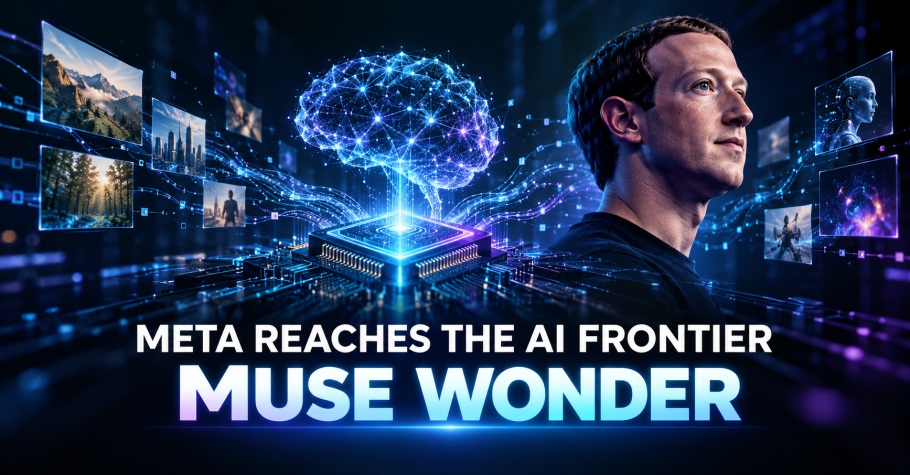
Meta is making a strong return to the artificial intelligence race. After investing billions of dollars in AI research, computing infrastructure, and specialist talent, the company has introduced Muse Wonder and Muse Wonder Full, two advanced AI models designed to compete with leading systems from OpenAI and Anthropic.
Announced on October 12, 2026, the new models represent a major milestone for Meta’s AI strategy. CEO Mark Zuckerberg has described the launch as a step towards the AI frontier, signalling that the company wants to be recognised as a leader in advanced AI development rather than simply a platform that integrates AI into its products.
What Is Meta Muse Wonder?
Muse Wonder is an advanced AI model developed by Meta Superintelligence Labs. It is designed to handle complex tasks that require planning, reasoning, coding, and working with information over multiple steps.
Meta has also introduced Muse Wonder Full, a more capable version aimed at demanding professional and software development tasks.
Unlike basic AI chatbots that mainly respond to individual questions, these models are built to support AI agents. These agents can plan tasks, use tools, work through problems, and continue towards a goal with less need for constant human input.
According to Meta, the models are designed for practical applications across areas such as software engineering, finance, law, and healthcare.
The models are available through the Meta Model API and Muse Code, with Muse Wonder Full offered to eligible Muse Code subscribers. Meta also plans to bring Muse Wonder into its Muse personal AI assistant experience.
How Muse Wonder Improves AI Agents
One of the key features of the Muse Wonder family is its focus on completing longer, more complicated tasks.
Meta highlights two capabilities that support this approach: Active Memory and Active Focus.
Active Memory: This feature helps the model retain relevant information across conversations and use that context when working on a task. It can make AI assistance more useful when a project requires several interactions rather than a single question and answer.
Active Focus: This capability helps the model continue working towards a goal when it encounters difficulties. It can explore alternative approaches, recover from errors, and ask for clarification when necessary.
Together, these features are intended to make AI agents more useful for real-world work.
For example, a developer could use an AI agent to examine a software project, identify problems, make changes across multiple files, and verify whether those changes work. Similarly, an AI assistant could help a user understand a complex insurance claim or review the main points of a lease.
These capabilities move AI beyond simple text generation towards systems that can help carry out multi-step tasks.
Why Muse Wonder Matters for Meta
Meta has spent heavily on AI infrastructure, research, and talent as competition in the industry has intensified. However, investment alone does not guarantee that a company will develop models capable of competing with the best systems available.
The Muse Wonder launch gives Meta a stronger product to support its ambitions.
Its earlier Muse models helped establish the foundations for this new generation. With Muse Wonder, Meta is now targeting more demanding tasks, including advanced coding and professional workflows.
The launch also follows the introduction of Muse, Meta’s personal AI agent, in September 2026. The company is building a closer connection between its underlying AI models and products designed for everyday users.
This strategy could help Meta distribute AI capabilities to a much larger audience. Its existing ecosystem of consumer applications provides potential routes for bringing AI-powered experiences to people who may not actively seek out standalone AI tools.
However, Meta will still need to demonstrate that its new models deliver consistent results in independent evaluations and everyday use.
Can Meta Compete With OpenAI and Anthropic?
The AI industry has become increasingly competitive, with companies racing to develop models that can reason, write code, use tools, and complete complex tasks.
OpenAI and Anthropic have established strong positions in advanced AI systems, particularly in reasoning and software development. Meta is now attempting to close the gap with the Muse Wonder family.
Meta reports strong performance across several agentic and coding evaluations. Its more advanced Muse Wonder Full model is designed to handle demanding workflows that require sustained effort and multiple steps.
However, benchmark results should not be the only measure of success. Reliability, speed, operating costs, security, and performance on real-world tasks will also influence whether developers and businesses adopt the models.
Availability is another important factor. Developers need clear pricing, dependable access, useful documentation, and tools that fit their existing workflows.
If Meta can deliver on these areas, Muse Wonder could become a serious option for businesses looking to build AI-powered applications and automate complex tasks.
What This Means for Businesses and Developers
The arrival of more capable AI agents could create new opportunities for businesses across several industries.
Software development teams may be able to automate parts of coding, testing, and debugging. Financial services companies could explore AI-assisted document analysis and customer support. Healthcare organisations may investigate administrative automation and information management, subject to appropriate privacy, safety, and regulatory safeguards.
For developers, access through an API creates opportunities to integrate AI capabilities into existing applications rather than building every feature from scratch.
At the same time, businesses should evaluate these systems carefully before deploying them in critical workflows. AI-generated outputs can still contain errors, and tasks involving financial, legal, medical, or personal information require appropriate oversight and security controls.
The practical value of an AI model depends not only on its intelligence but also on how safely and reliably it can be used.
What Comes Next for Meta’s AI Strategy?
Muse Wonder marks an important step in Meta’s attempt to strengthen its position in the AI market. The company is combining advanced models, AI agents, developer tools, and its consumer technology ecosystem to create a broader AI platform.
For Zuckerberg and Meta’s AI leadership, the launch provides a reason to be more confident about the company’s progress. But reaching the AI frontier is not a one-time achievement. Competitors continue to improve their models, and expectations around AI capabilities are changing rapidly.
The next challenge will be turning strong model performance into products that people trust and businesses find valuable.
Final Thoughts
Meta’s Muse Wonder launch shows how sustained investment can help a technology company regain momentum in a highly competitive market. With improved support for memory, long-running tasks, and advanced coding, Meta is positioning itself as a stronger competitor to OpenAI and Anthropic.
Whether this marks a lasting comeback will depend on real-world performance, developer adoption, and the company’s ability to turn its AI capabilities into reliable products.
For now, Meta has made its intentions clear: it wants to play a leading role in the next phase of artificial intelligence.

- Meta Reaches the AI Frontier With Muse Wonder: Zuckerberg’s Big Comeback - October 15, 2026
- Anthropic Launches Claude Haiku 5.5 With 75% Lower Average Cost - October 8, 2026
- OpenAI DevDay 2026: Dots, GPT-6.1 Sol and the Push Beyond Chatbots - September 30, 2026


