
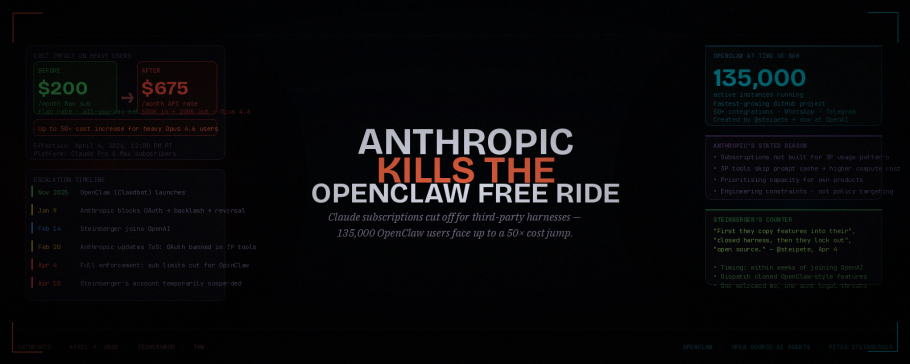
In early April 2026, a major change shook the open-source AI community. Anthropic, the company behind Claude, suddenly stopped allowing its paid subscribers to use Claude through third-party tools like OpenClaw. This decision forced thousands of users to switch to a more expensive pay-as-you-go model.
This move has sparked debates about cost, control, and the future of open AI ecosystems.
What Exactly Happened?
OpenClaw is a popular open-source AI agent framework that allows users to run AI assistants with memory, tools, and automation. Many users connected it to Claude using their subscription accounts, which offered a flat monthly fee.
But on April 4, 2026, Anthropic blocked this access. Users could no longer use their Claude Pro or Max subscription inside OpenClaw. Instead, they now have to:
- Pay per usage using API billing
- Or switch to another AI provider
This change happened with less than 24 hours’ notice, leaving many users unprepared.
Why Did Anthropic Make This Move?
Anthropic says the reason is technical and financial.
AI agents like OpenClaw generate heavy workloads. Unlike normal chat usage, these tools run multiple automated steps, creating huge volumes of requests. Subscription pricing was never designed for this level of usage.
In simple terms, Anthropic was losing money on heavy users.
Another reason is efficiency. Claude’s official tools are optimized to reduce computing costs, but third-party apps like OpenClaw do not use these optimizations. This makes them more expensive to run.
So from a business point of view, the decision makes sense.
Why Is the Community Upset?
While the reasoning may be valid, the way it was implemented caused frustration.
- Short notice: Developers had less than a day to react
- High cost increase: Some users saw costs rise up to 20–50 times
- Broken workflows: Many AI agents stopped working instantly
For power users running advanced AI tasks, this was a major disruption.
There is also a deeper concern. Many in the community feel this move limits open innovation. OpenClaw allowed developers to experiment freely with AI agents. Blocking access makes it harder to build and scale such tools.
The Bigger Picture: Control vs Open Innovation
This situation highlights a growing tension in AI.
On one side are companies like Anthropic that build powerful models and need sustainable revenue. On the other side are open-source developers who want flexibility and freedom to build new tools.
Initially, open ecosystems help AI companies grow by increasing adoption. But as usage scales, costs rise. Companies then tighten control to protect their business.
This pattern is not new, but it is becoming more visible in AI.
What Happens to OpenClaw Now?
OpenClaw is still active, but users need to adjust.
They now have three main options:
- Use Claude API
This is the official route. It is reliable but can be expensive for heavy usage. - Enable extra usage billing
This allows users to continue with Claude but adds additional costs. - Switch to other AI providers
Some users are moving to alternatives that still support subscription-based usage.
This shift may change how developers choose AI platforms in the future.
Key Lesson for Developers
The biggest takeaway is simple: relying on unofficial integrations can be risky.
OpenClaw’s growth was partly based on using Claude subscriptions in a way that was not fully supported. Once that loophole closed, the entire system changed overnight.
Developers building AI tools should:
- Plan for API-based pricing
- Avoid depending on undocumented features
- Build flexible systems that support multiple AI providers
Final Thoughts
Anthropic’s decision is a turning point for the AI ecosystem. It shows that as AI tools become more powerful and widely used, companies will enforce stricter rules around access and pricing.
For users, it means higher costs and fewer shortcuts.
For developers, it means building smarter and more resilient systems.
The balance between open innovation and business sustainability is still evolving—and this is just the beginning.

- Amazon Drone Delivery to Reach Nearly 500 Cities - August 20, 2026
- Alibaba AI Models Hit 3 Billion Downloads, Overtaking Meta and Google - August 17, 2026
- Google Pixel 11 Unveiled With Gemini at the Centre of the AI Phone War - August 14, 2026


