
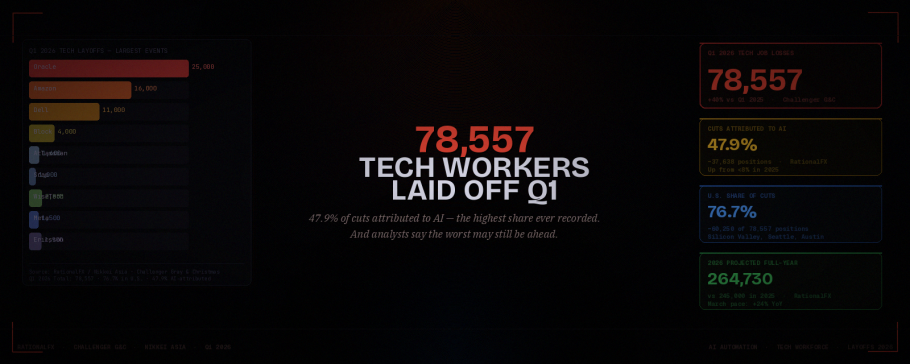
The first three months of 2026 have been tough for the tech industry. Over 78,000 workers lost their jobs globally, and nearly half of those layoffs were linked to artificial intelligence. This is not just another round of cost-cutting. It marks a real shift in how companies are using AI to reshape their workforce.
For years, AI was seen as a tool to assist humans. Now, it is starting to replace certain roles completely. Companies are openly saying that automation and AI tools are helping them do more work with fewer people.
Why Are So Many Jobs Being Cut?
The main reason behind these layoffs is simple. AI tools have become powerful enough to handle tasks that once required human workers. From writing code to managing customer support, AI is taking over routine and repetitive work.
Big companies are leading this shift. Businesses like enterprise software firms, cloud providers, and tech platforms are investing heavily in AI infrastructure. To fund these investments, they are cutting costs elsewhere, often by reducing their workforce.
Another reason is efficiency. Companies are under pressure to improve profits and show returns on their AI investments. If AI can do the work of multiple employees, organisations see it as a way to save money and move faster.
Is AI Really Replacing Jobs or Just an Excuse?
There is an ongoing debate about whether AI is truly the main reason behind these layoffs. Some experts believe companies are using AI as an excuse for decisions they would have made anyway.
This idea is often called “AI washing.” It means businesses blame AI for job cuts, even if the real reasons include over-hiring in previous years or economic pressure.
However, there is also clear evidence that AI is genuinely replacing certain roles. In some companies, entire teams have been reduced because AI tools can now handle their work more efficiently. So, the truth likely lies somewhere in between. AI is both a real disruptor and a convenient justification.
Which Jobs Are Most at Risk?
Not all roles are equally affected. The biggest impact is seen in:
- Entry-level software developers
- Customer support teams
- Data entry roles
- Quality assurance and testing
- Middle management positions
These jobs often involve repetitive tasks, which AI can now handle quickly and accurately.
Where Are New Opportunities Emerging?
While many jobs are being lost, new roles are also being created. Companies are hiring for:
- AI engineers
- Machine learning specialists
- Data scientists
- AI product managers
- Prompt engineers
In fact, AI-related job postings have increased significantly in 2026. This shows that the job market is not shrinking overall. Instead, it is changing.
The challenge is that workers losing their jobs may not have the skills needed for these new roles. This creates a gap between job losses and job opportunities.
The Bigger Economic Impact
The layoffs are not just affecting individuals. They are also impacting the economy. High-paying tech jobs contribute significantly to local economies. When thousands of workers lose their income, it affects spending, housing markets, and overall growth.
Cities like San Francisco, Seattle, and Austin are feeling this impact the most. These regions depend heavily on tech jobs, so large layoffs create ripple effects across multiple industries.
What Should Businesses Do Next?
For companies, the focus should not only be on cutting costs but also on long-term strategy. Relying too much on AI without investing in people can create future problems, especially when experienced talent becomes scarce.
Businesses should consider:
- Upskilling existing employees
- Investing in AI responsibly
- Balancing automation with human expertise
- Building roles that work alongside AI, not against it
What Should Employees Do?
For workers, adapting to this change is crucial. Learning AI-related skills is becoming more important across all industries. Even basic understanding of how AI tools work can improve job security.
The future workforce will not be replaced by AI completely. Instead, it will be shaped by how well humans and AI work together.
Final Thoughts
The 2026 layoffs are a clear sign that AI is no longer just a future trend. It is already transforming the job market.
While the transition may be challenging, it also brings new opportunities. The key is to adapt, learn, and stay ahead of the changes.

- Amazon Drone Delivery to Reach Nearly 500 Cities - August 20, 2026
- Alibaba AI Models Hit 3 Billion Downloads, Overtaking Meta and Google - August 17, 2026
- Google Pixel 11 Unveiled With Gemini at the Centre of the AI Phone War - August 14, 2026


