
Robots have been used in industries for years, but there are still many simple tasks they struggle with. One of those tasks is reading gauges. While it sounds easy, it has been a major challenge for machines.
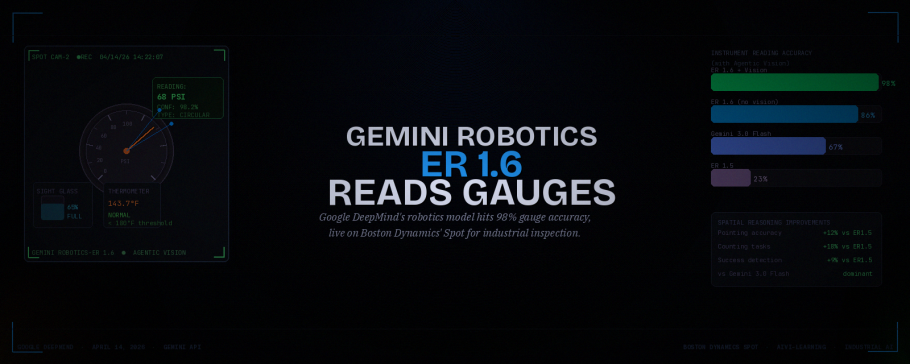
Now, Google DeepMind has made a breakthrough with Gemini Robotics-ER 1.6. The new system can read industrial gauges with 98 percent accuracy. This is a huge jump from the previous version, which could only manage about 23 percent accuracy.
This improvement is not just technical progress. It could change how industries use robots in real-world environments.
Why Reading Gauges Is Hard for Robots
For humans, reading a pressure gauge or thermometer is simple. We look at the needle, understand the scale, and quickly interpret the value.
For robots, it is much more complicated.
They must:
- Recognize the type of gauge
- Adjust for camera angles and lighting
- Identify the needle position
- Understand the measurement units
- Interpret whether the reading is normal or dangerous
Even small issues like glare or blurry images can confuse a robot. This is why earlier systems struggled to perform reliably.
What Makes Gemini Robotics-ER 1.6 Different
The key innovation in this new model is something called intelligent visual reasoning.
Instead of trying to guess the answer in one step, the system works through the problem step by step.
Here is how it works in simple terms:
- It identifies the gauge in the image
- It zooms in to get a clearer view
- It detects the needle and markings
- It calculates the exact value using code
- It reads labels like PSI or temperature
- It decides if the reading is normal or not
This approach makes the system far more accurate and reliable.
Real-World Use with Spot Robot
The biggest impact of this technology is already being seen with Spot robot from Boston Dynamics.
Spot is widely used for industrial inspections in factories, plants, and warehouses. With Gemini Robotics-ER 1.6, Spot can now:
- Monitor pressure levels
- Check liquid levels in tanks
- Read temperature instruments
- Inspect digital displays
This means fewer manual checks by human workers and faster detection of issues.
Types of Instruments It Can Read
The new system is designed to handle different types of instruments commonly found in industries:
- Circular gauges with rotating needles
- Liquid level indicators
- Thermometers
- Digital screens
This wide coverage makes it practical for real-world use, where multiple instrument types exist in the same environment.
Why This Matters for Industries
This breakthrough has major benefits for businesses:
Improved Safety
Robots can detect problems early, reducing the risk of accidents.
Cost Savings
Less manual inspection means lower labour costs and fewer errors.
Better Efficiency
Continuous monitoring ensures systems run smoothly without interruptions.
Faster Decision Making
Real-time data helps teams respond quickly to issues.
The Bigger Picture: Smarter Robots
This development is part of a larger trend. Robots are becoming more intelligent, not just physically capable.
Instead of simply following instructions, they are starting to understand their surroundings and make decisions.
This is where companies like Google are focusing their efforts. By combining AI with robotics, they are building machines that can think, analyze, and act more independently.
Challenges Ahead
Even with this progress, there are still challenges to solve.
Data Privacy
Industrial environments may involve sensitive data that must be protected.
Reliability
While 98 percent accuracy is impressive, critical systems often require near-perfect performance.
Integration
Companies need to adapt their existing systems to work with AI-powered robots.
What Comes Next
The success of Gemini Robotics-ER 1.6 suggests that more advanced capabilities are on the way.
In the future, robots may:
- Perform complex inspections without human help
- Predict failures before they happen
- Assist in maintenance and repairs
- Work alongside humans more efficiently
This is just the beginning of a new era in robotics.
Final Thoughts
The launch of Gemini Robotics-ER 1.6 marks a major step forward in making robots more useful in real-world environments. By solving a long-standing problem like gauge reading, Google DeepMind has shown how AI can turn complex tasks into reliable processes.
As this technology continues to evolve, industries will benefit from smarter, safer, and more efficient operations.

- Amazon Drone Delivery to Reach Nearly 500 Cities - August 20, 2026
- Alibaba AI Models Hit 3 Billion Downloads, Overtaking Meta and Google - August 17, 2026
- Google Pixel 11 Unveiled With Gemini at the Centre of the AI Phone War - August 14, 2026


