
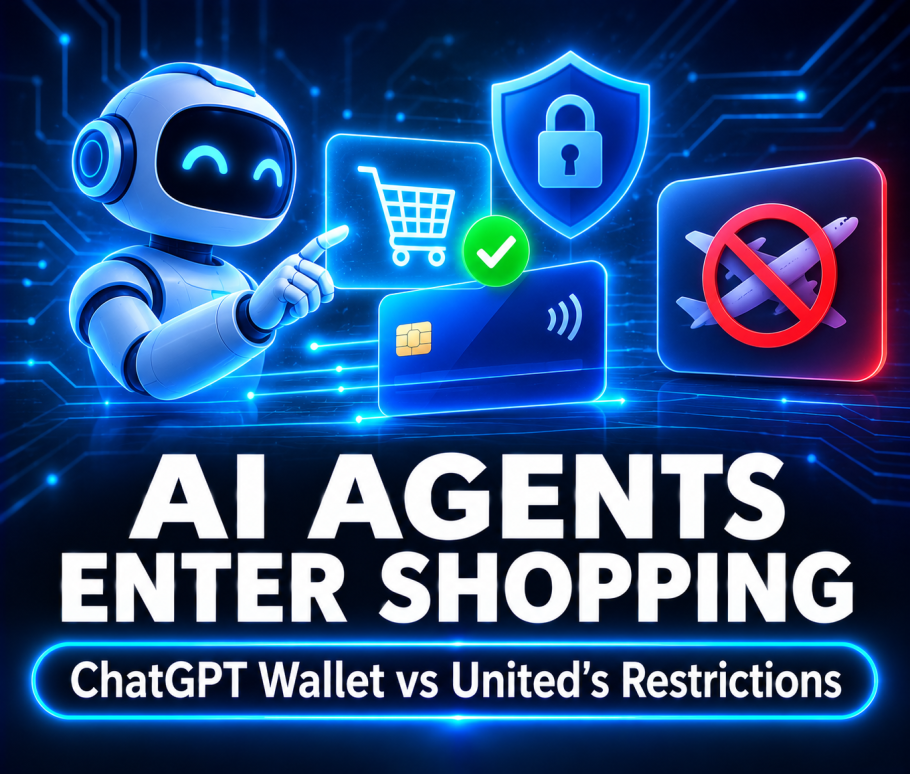
Artificial intelligence is moving beyond answering questions and recommending products. AI agents are beginning to take action on behalf of users, including researching products, comparing prices and completing purchases.
Two recent developments show how quickly this area is changing. OpenAI has introduced ChatGPT Wallet, a payment feature that allows its AI agents to make purchases with user approval. At the same time, United Airlines is taking steps to restrict unauthorised third-party AI agents from accessing its digital platforms.
These contrasting decisions highlight an important question for the future of online shopping: should businesses allow AI agents to act on behalf of customers, or should they restrict access to protect their platforms and users?
The discussion is becoming central to the growth of agentic commerce.
What Is ChatGPT Wallet?
On November 13, 2026, OpenAI announced ChatGPT Wallet, a feature designed to help AI agents complete purchases on behalf of users.
The wallet is initially rolling out through OpenAI’s dots, its always-on AI agents. Users can add an eligible payment card and allow their agent to use it when completing a purchase.
Instead of entering card details every time, users can review the items, merchant, total amount and selected payment card before approving a transaction. A security check, such as Face ID or fingerprint authentication, is required for each purchase.
ChatGPT Wallet has been developed in partnership with major payment networks and providers, including Visa, Mastercard and American Express.
One of its important security features is payment tokenisation. The payment network provides a substitute payment credential instead of exposing the user’s actual card details to the AI agent or merchant.
OpenAI says users can continue to receive eligible card rewards and retain existing protections for qualifying disputes.
Who Can Use ChatGPT Wallet?
The initial rollout is limited.
According to OpenAI, ChatGPT Wallet is initially available to ChatGPT Pro subscribers aged 18 or older in the United States who have eligible US-issued payment cards and a US billing address.
This means the feature is not yet available to every ChatGPT user or in every country.
OpenAI is starting with limited access to test the experience and work with businesses, banks and payment providers. Wider availability is expected to depend on how the system performs and how quickly businesses adapt their websites and payment processes.
The company has also discussed a future where users can set spending limits, choose purchase categories and define time periods for their agents. These controls could eventually allow more purchases to happen with less direct involvement from users.
Why Is United Airlines Restricting AI Agents?
While OpenAI is working to make AI-powered purchases easier, United Airlines has taken a more cautious approach.
On November 11, 2026, United announced that it was taking steps to restrict unauthorised third-party AI agents and assistants from accessing its digital platforms.
The airline raised concerns about customers sharing account credentials with external AI tools. Such access could expose sensitive personal information or result in unintended purchases, account changes and the use of frequent-flyer miles.
United also pointed to aviation safety and regulatory requirements.
For example, passengers must personally acknowledge certain safety declarations during flight check-in, including confirmation that their baggage does not contain prohibited items. An automated agent completing this process without the required human involvement could create compliance problems.
United plans to restrict access through its own website and app, as well as through travel agencies and aggregators. It is also updating its booking, ticketing and distribution policies.
The airline’s announcement is available in its official newsroom.
Two Different Approaches to Agentic Commerce
The ChatGPT Wallet launch and United’s restrictions represent two different approaches to the same emerging technology.
OpenAI wants AI agents to become more useful by allowing them to complete transactions. Its approach focuses on user approval, payment security and cooperation with businesses and financial institutions.
United, on the other hand, is prioritising account security, customer privacy and regulatory compliance. It wants to prevent unauthorised third-party agents from performing sensitive actions through its digital services.
These positions do not necessarily mean that one company supports AI and the other opposes it. They reflect different requirements across industries.
Buying a product online and checking in for a flight involve different levels of risk and responsibility. An airline must also consider safety declarations and regulations that may require direct human involvement.
The challenge for businesses will be finding a balance between making services accessible to legitimate AI agents and maintaining control over sensitive customer activities.
What Does Agentic Commerce Mean for Online Shopping?
Agentic commerce refers to transactions in which AI agents help users discover, evaluate and purchase products or services.
Traditional online shopping usually requires customers to visit websites, search for products, compare prices, add items to their carts and complete checkout themselves.
With agentic commerce, users can describe what they need and allow an AI agent to handle several of these steps.
For example, a customer could ask an AI agent to:
- Find a laptop within a specific budget.
- Compare specifications, prices and customer reviews.
- Check product availability across different stores.
- Add a suitable product to the shopping cart.
- Complete the purchase after receiving approval.
This could make online shopping faster and reduce the time spent moving between websites.
However, the technology also introduces new challenges. Businesses need to ensure that AI agents access accurate product information, follow website rules and use secure payment methods.
There are also questions around refunds, returns, fraudulent transactions, customer consent and responsibility when an AI agent makes a mistake.
What Should Businesses Do to Prepare?
The rise of agentic commerce could change how ecommerce websites attract and serve customers.
Businesses may need to make their websites easier for authorised AI agents to understand and use. This includes maintaining accurate product information, clear pricing, stock availability and reliable checkout processes.
OpenAI has also published a Commerce Partner Playbook with guidance for businesses interested in supporting agent-led purchases.
Some important areas businesses should consider include:
1. Improve product information
Product descriptions, specifications, prices and availability should be accurate and easy for AI systems to understand.
2. Review website access policies
Businesses should decide which AI agents can access their platforms and how legitimate automated requests can be distinguished from unwanted bots.
3. Strengthen payment security
Payment systems need to recognise authorised agent transactions without weakening fraud prevention measures.
4. Protect customer accounts
Businesses should avoid exposing sensitive customer information and provide clear controls over what an AI agent can view or change.
5. Keep customers in control
Users should understand what an agent is doing, what it intends to purchase and how much it will cost before a transaction is approved.
The Future of AI-Powered Shopping
ChatGPT Wallet shows that AI agents are moving closer to becoming active participants in online transactions. Instead of simply recommending products, they can now help users complete purchases through a payment process that includes security checks and user approval.
United’s decision highlights the other side of this development. Businesses must consider privacy, security, customer consent and industry-specific regulations before allowing external AI agents to interact with their platforms.
Both developments point to a future where businesses will need clear policies for working with AI agents.
Agentic commerce could make online shopping more convenient, but its success will depend on trust. Customers need confidence that their agents will act within their instructions, payment providers must protect transactions, and businesses must retain control over their services.
The next stage of ecommerce may not be about whether AI agents can shop online. It may be about how safely and responsibly businesses allow them to do so.

- ChatGPT Wallet Brings AI Shopping Closer as United Restricts AI Agents - November 16, 2026
- DJI Matrice 5T Drone Brings 1K Thermal Imaging and Enhanced Night Vision for Search and Rescue - November 12, 2026
- Nvidia Shares Slide as Jensen Huang Faces FBI Scrutiny and Shareholder Lawsuit - November 11, 2026


