
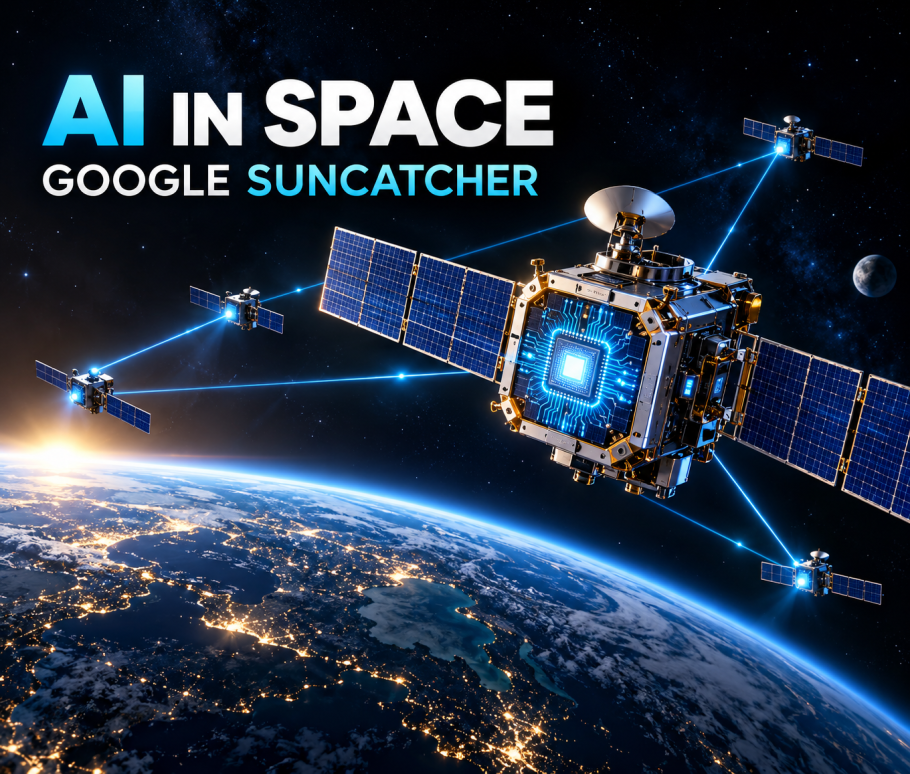
Google is taking another step towards one of the most ambitious ideas in artificial intelligence infrastructure: putting AI computing hardware in space.
The company has confirmed that its Project Suncatcher research programme is preparing for its first orbital test. A prototype satellite carrying four Google Tensor Processing Units, or TPUs, is scheduled to launch aboard a SpaceX rideshare mission.
The test is designed to answer a fundamental question before Google attempts anything on a much larger scale: Can AI computing hardware operate reliably in orbit?
The development marks an important transition for Project Suncatcher. What began as a research concept is now moving into physical testing.
What Is Google’s Project Suncatcher?
Project Suncatcher is Google’s long-term research effort to investigate whether large-scale machine learning infrastructure could eventually operate in space.
The concept is based on a simple advantage: satellites in low Earth orbit can receive near-constant sunlight, potentially providing abundant solar energy for computing.
Google says satellites could eventually be connected into large constellations capable of processing AI workloads while orbiting Earth.
However, the company is not claiming that a giant orbital data centre is ready today.
The first mission is deliberately small.
Four Google TPUs Are Going Into Orbit
The initial prototype satellite will carry four Google TPUs, allowing engineers to study how the company’s AI hardware performs outside Earth’s atmosphere.
The spacecraft is expected to launch on October 1, 2026, as part of SpaceX’s Transporter-18 rideshare mission, according to reporting on Google’s announcement.
The test will expose the hardware to conditions that cannot be perfectly replicated on Earth, including:
- Radiation
- Extreme thermal conditions
- Vacuum
- Launch forces
- Limited cooling options
- Orbital communications
The results will help Google determine what needs to change before attempting larger deployments.
Why Put AI Compute in Space?
The biggest motivation is energy.
Modern AI data centres consume enormous amounts of electricity. Building enough power generation and cooling infrastructure on Earth is becoming an increasingly important challenge as demand for AI computing grows.
Space offers a different environment.
Google says satellites in low Earth orbit can receive up to eight times more solar power than on Earth, potentially creating an attractive source of energy for future computing infrastructure.
There is also the possibility of reducing some of the land and power infrastructure requirements associated with massive terrestrial data centres.
But those advantages come with completely different engineering problems.
Cooling Is One of the Biggest Challenges
Putting an AI processor in space does not automatically solve the heat problem.
In fact, cooling may become one of the biggest engineering challenges.
On Earth, data centres can use air or liquid cooling systems to move heat away from processors.
In space, there is no atmosphere to carry heat away.
Google therefore needs to rely on technologies such as heat pipes and radiators to transfer heat from the TPUs and release it through radiation. The company says it has already tested its cooling technology inside thermal vacuum chambers on Earth.
The upcoming mission will provide real-world data.
Satellites Will Need to Work Together
A full orbital AI infrastructure system would require much more than putting processors on individual satellites.
The satellites would need to communicate with one another at extremely high speeds.
Google is investigating laser-based connections between satellites as part of this challenge.
Future designs could place dozens of TPU chips on individual satellites and connect multiple satellites into clusters.
Google plans to test this inter-satellite communication technology in 2027 with two satellites in orbit.
If successful, this could eventually allow AI workloads to move across an orbital computing network.
SpaceX Is Becoming Part of the AI Infrastructure Race
SpaceX is also developing its own vision for orbital AI computing.
Its 2026 prospectus describes plans to use Starlink-derived satellite technology to support orbital AI compute, including solar-powered satellites, radiative cooling and rapid hardware upgrades.
Google’s relationship with SpaceX therefore has significance beyond simply providing a launch vehicle.
The two companies have also entered a major terrestrial computing agreement. SpaceX disclosed a deal under which Google will pay approximately $920 million per month for access to about 110,000 GPUs, CPUs, memory and related components from October 2026 through June 2029.
The terrestrial agreement and Project Suncatcher are separate initiatives, but together they demonstrate how quickly the infrastructure surrounding AI is expanding.
From Four Chips to an Orbital Data Centre
It is important to keep the scale of today’s announcement in perspective.
Four TPUs on an experimental satellite are nowhere near the computing capacity of a conventional hyperscale data centre.
Google itself describes the current mission as a methodical engineering step intended to identify failures and gather information for future designs.
The longer-term vision is much larger.
Google wants to determine whether interconnected satellite constellations could eventually provide scalable machine learning infrastructure in orbit.
That would represent a fundamental change in how AI computing infrastructure is designed.
The AI Infrastructure Problem Is Moving Beyond Earth
The rapid growth of AI is creating demand for more chips, electricity, cooling systems and data-centre capacity.
Technology companies are therefore exploring increasingly unconventional ways to expand computing infrastructure.
Google’s Project Suncatcher represents one of the most futuristic approaches.
Instead of continuously building larger data centres on Earth, the company is investigating whether some AI workloads could eventually be moved into orbit.
The idea remains experimental, and significant technical and economic questions still need to be answered.
What Happens Next?
The immediate milestone is the first orbital test.
Google will use the mission to collect data on:
- TPU performance
- Radiation exposure
- Thermal behaviour
- Power generation
- Cooling
- Satellite communications
- Overall system reliability
The company plans to use those findings to inform future Project Suncatcher missions.
The next major step is expected in 2027, when Google plans to test satellite-to-satellite laser communication with two spacecraft.
Final Thoughts
Google’s Project Suncatcher is no longer just a theoretical discussion about putting AI in space.
The company is preparing to put actual TPU hardware into orbit and test how it behaves in the real environment.
The current mission is small, but its implications are much larger.
If Google can eventually solve the problems of cooling, communication, radiation protection, reliability and launch economics, orbital computing could become another part of the global AI infrastructure landscape.
For now, however, Project Suncatcher remains an ambitious research programme rather than a fully operational space data centre.
The next few missions will determine whether Google’s vision can move from science-fiction concept to practical AI infrastructure.

- Google Sends AI Chips Into Space as Project Suncatcher Moves Toward Orbital Compute - September 25, 2026
- Adobe Names Anil Chakravarthy as CEO, Shantanu Narayen to Become Executive Chair - September 8, 2026
- OpenAI Astra Rated a “Critical” Cyber Risk - September 3, 2026


