
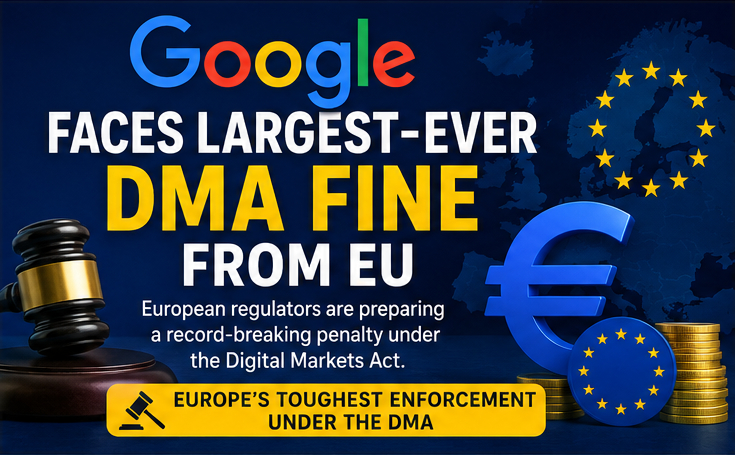
Google is once again under major pressure from European regulators. This time, the company could face the biggest Digital Markets Act fine ever issued by the European Union.
According to reports, European authorities are preparing a high triple digit million euro penalty against Google over concerns related to search self preferencing. The fine is expected to be announced before the summer break and could become one of the toughest enforcement actions ever taken under Europe’s new digital competition rules.
This move shows that the European Union is becoming far more aggressive when it comes to regulating large technology companies.
But what exactly is the issue, and why is Google facing such a massive penalty?
What Is the Digital Markets Act?
The Digital Markets Act, also known as DMA, is a major European law created to control the power of large technology platforms.
The European Union introduced the law to ensure fair competition in digital markets. The DMA mainly targets large companies that act as “gatekeepers” because they control major online platforms and services.
Companies like Google, Apple, Meta, Amazon, and Microsoft fall under these rules.
The goal of the DMA is simple:
- Prevent unfair competition
- Stop companies from abusing market dominance
- Give smaller businesses a fair chance
- Protect consumer choice
- Increase transparency in digital services
European regulators believe some large tech companies use their size and platform control to favor their own services over competitors.
That is exactly where Google’s latest problem begins.
Why Is Google Being Investigated?
The main issue involves something called search self preferencing.
This means regulators believe Google may be giving unfair advantages to its own products and services inside Google Search results.
For example, if users search for:
- Shopping products
- Hotels
- Flights
- Restaurants
- Maps
- Reviews
Google may prioritize its own services above competing businesses.
Critics argue this creates an unfair marketplace because Google controls both:
- The search platform itself
- The services being promoted
This could make it harder for smaller competitors to gain visibility online.
European regulators believe this behavior may violate the Digital Markets Act.
Europe Is Taking a Much Tougher Approach
The expected fine shows how serious Europe has become about enforcing digital competition laws.
In the past, regulators often issued warnings or smaller penalties. But under the DMA, the European Union now has stronger legal powers.
Companies that break DMA rules can face:
- Massive financial penalties
- Business restrictions
- Mandatory platform changes
- Increased regulatory oversight
The law allows regulators to fine companies up to 10 percent of their global annual revenue for major violations.
For a company like Google, that could potentially mean billions of euros.
Even though the upcoming fine may not reach that maximum level, it could still become the largest DMA penalty issued so far.
Why Search Self Preferencing Matters
At first glance, search rankings may not seem like a major issue.
But in today’s digital world, search visibility directly impacts:
- Website traffic
- Online sales
- Advertising revenue
- Brand awareness
- Business growth
Google Search remains one of the most powerful internet gateways in the world.
If Google gives priority to its own services, competitors may struggle to reach customers even if they offer better products or services.
Smaller businesses and European regulators argue this weakens market competition.
Supporters of stricter regulation believe tech companies should act as neutral platforms instead of promoting their own products unfairly.
Google’s Growing Regulatory Challenges
This is not the first time Google has faced antitrust and competition related investigations in Europe.
Over the years, the company has already received several large fines related to:
- Android practices
- Shopping search results
- Advertising systems
- Data handling concerns
However, the DMA represents a new phase of regulation.
Instead of reacting after years of investigations, Europe now wants faster enforcement and quicker penalties.
This creates a much more difficult environment for large tech companies operating in Europe.
Google now faces increasing pressure to redesign how some of its services work.
What This Means for Users
For everyday users, these legal battles may eventually change how digital platforms operate.
If regulators force Google to change its search system, users could start seeing:
- More diverse search results
- Better visibility for smaller businesses
- More competition between services
- Increased transparency in recommendations
Some experts believe this could improve consumer choice online.
Others argue that too much regulation may reduce product integration and convenience.
Either way, Europe’s actions are likely to influence how digital platforms operate globally.
Big Tech Regulation Is Expanding Worldwide
Europe is currently leading global tech regulation efforts, but other countries are watching closely.
Governments around the world are becoming increasingly concerned about the influence of large technology companies.
Issues like:
- Market dominance
- AI competition
- User privacy
- Data control
- Platform monopolies
are now major global policy discussions.
The outcome of Google’s DMA case could influence future regulations in:
- The United States
- Canada
- India
- Australia
- South Korea
If Europe succeeds in enforcing stronger platform rules, other regions may introduce similar laws.
AI and Search Could Make Regulation Even More Complex
Another reason this case matters is because AI powered search is rapidly growing.
Google is heavily integrating Gemini AI into Search and other products.
As AI generated answers become more common, regulators may start asking even tougher questions about:
- Which services AI recommends
- How search rankings are generated
- Whether AI systems favor company owned products
- Transparency in AI powered results
This means future competition laws may expand far beyond traditional search rankings.
AI could become the next major battleground between regulators and technology companies.
Final Thoughts
Google potentially facing the largest ever DMA fine shows that Europe is serious about controlling the power of major digital platforms.
The case is not just about search rankings. It is about who controls visibility, competition, and access across the modern internet.
For Google, this could lead to significant changes in how its search platform operates in Europe.
For businesses and users, it may reshape online competition and digital experiences in the years ahead.
One thing is clear. The era of light regulation for big tech companies is ending, and Europe is leading the charge.

- Amazon Drone Delivery to Reach Nearly 500 Cities - August 20, 2026
- Alibaba AI Models Hit 3 Billion Downloads, Overtaking Meta and Google - August 17, 2026
- Google Pixel 11 Unveiled With Gemini at the Centre of the AI Phone War - August 14, 2026


