
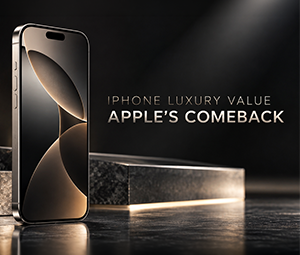
For years, owning an iPhone meant more than simply owning a smartphone. It represented premium design, status, exclusivity and a certain lifestyle. Apple successfully turned the iPhone into one of the world’s most recognisable premium technology brands.
But the smartphone market has changed.
With Samsung, Google, Huawei and other manufacturers offering increasingly advanced flagship devices, the difference between an iPhone and other premium smartphones is no longer as obvious as it once was. iPhones have also become increasingly common, making the device feel less exclusive in some markets.
This has raised an important question about iPhone luxury brand value.
Has the iPhone lost some of the exclusivity that once made it a status symbol? And more importantly, what is Apple doing to bring that value back?
From premium Pro models and new designs to artificial intelligence and its move into foldable smartphones, Apple appears to be creating a new strategy for the iPhone’s premium image.
What Made the iPhone a Luxury Brand?
When Apple launched the original iPhone in 2007, it changed how people viewed smartphones.
Instead of treating a smartphone purely as a communication device, Apple presented the iPhone as a combination of technology, design and lifestyle.
The iPhone quickly became associated with:
- Premium design
- High-quality materials
- Strong brand recognition
- High resale value
- Apple’s software ecosystem
- Innovation
- Status
This combination helped Apple build significant iPhone luxury brand value over the years.
The company wasn’t simply selling a phone. It was selling an experience.
The Apple logo, minimalist design, premium packaging and carefully controlled retail experience all contributed to the perception that the iPhone was something special.
Why iPhone Luxury Brand Value Started to Decline
The issue isn’t necessarily that iPhones became less premium.
Instead, competing smartphones became much better.
Samsung’s Galaxy Ultra range, Google’s Pixel Pro phones and flagship devices from Chinese manufacturers now offer premium displays, powerful cameras, fast processors, advanced AI features and sophisticated designs.
Features that were once strongly associated with Apple’s premium positioning are now common across the high-end smartphone market.
This has affected the perception of iPhone luxury brand value.
iPhones Became More Common
Luxury and exclusivity are closely connected.
A product can remain expensive and premium while becoming widely available, but widespread ownership can reduce the feeling that it is a status symbol.
The iPhone is now one of the world’s most recognisable smartphones. Apple has built a huge installed user base across markets including the US, Europe, China and India.
That scale is excellent for Apple’s business.
However, it creates a branding challenge:
How can Apple make the iPhone feel exclusive when millions of people already own one?
This is where Apple’s current strategy becomes particularly interesting.
Apple Still Has Enormous Premium Smartphone Power
Although discussions about declining iPhone luxury brand value have increased, Apple’s position in the premium smartphone market remains extremely strong.
Counterpoint Research data reported in 2026 showed Apple holding around 65% of the global premium smartphone market during the first half of the year, with premium defined as smartphones with wholesale prices of $600 or more.
This suggests an important distinction.
The iPhone may not feel as exclusive as it did during its early years, but Apple still has enormous power in the premium smartphone segment.
The challenge for Apple isn’t simply maintaining premium sales.
It is maintaining the emotional and aspirational value of the iPhone brand.
Apple Is Raising the Luxury Ceiling
One of Apple’s most interesting strategies is to create a higher tier above its traditional iPhone models.
The arrival of Apple’s first foldable iPhone is a major part of that strategy.
The iPhone Duo starts at around $1,999 in the US, placing it significantly above Apple’s standard flagship models.
That price changes the conversation around iPhone luxury brand value.
Instead of trying to make every iPhone exclusive, Apple can create an ultra-premium category for consumers who want the newest and most distinctive technology.
The product hierarchy becomes something like:
iPhone → iPhone Pro → iPhone Duo
This approach gives Apple more room to create aspiration at the top of its smartphone range.
The Foldable iPhone Could Change Apple’s Luxury Image
Foldable smartphones are not new.
Samsung and several Chinese smartphone manufacturers have already spent years developing foldable devices.
However, Apple’s entry into the category has the potential to change how consumers perceive the technology.
A foldable iPhone priced close to $2,000 is not positioned simply as another smartphone upgrade.
It is a statement product.
For Apple, this could become an important tool for rebuilding iPhone luxury brand value.
The foldable design provides something the standard iPhone cannot easily offer: visible differentiation.
When someone opens a foldable iPhone in public, the product immediately looks different from a conventional smartphone.
That kind of visual distinction matters for luxury positioning.
Premium Pricing Can Support Brand Value
Price is not the only factor that determines luxury.
However, pricing can influence how consumers perceive a product.
Apple has gradually created more separation between its standard iPhones and Pro models. The most expensive configurations include better cameras, larger storage options and additional premium features.
The strategy allows consumers to enter the Apple ecosystem at different price points while giving the company an opportunity to create a highly premium tier.
This product segmentation could help protect iPhone luxury brand value.
Apple doesn’t need every iPhone to be perceived as an ultra-luxury product.
Instead, the company can make its highest-end products aspirational.
Design Remains One of Apple’s Biggest Advantages
Apple’s design philosophy has always played an important role in its brand.
The company has consistently focused on materials, proportions, colours, finishes and the overall physical experience of its devices.
This is particularly important in the luxury technology market.
Consumers don’t only compare processors and camera specifications. They also consider how a device looks and feels.
Apple’s ability to control both hardware and software gives it significant control over the overall experience.
That contributes to the broader iPhone luxury brand value.
A premium device needs to feel premium every time the owner picks it up.
AI Could Become the Next Premium Differentiator
Artificial intelligence is another important part of Apple’s strategy.
Google, Samsung, OpenAI and other technology companies have pushed AI rapidly into smartphones and digital services.
For Apple, this creates both a challenge and an opportunity.
If consumers begin viewing AI as one of the most important smartphone features, Apple needs to ensure that the iPhone remains associated with advanced technology.
Apple’s newer AI initiatives and more capable Siri experience are therefore important to the future of iPhone luxury brand value.
The premium smartphone of the future may not be defined only by its camera or processor.
It may also be defined by how intelligently it understands the user and how seamlessly it works across apps and devices.
Apple’s Ecosystem Makes the iPhone More Valuable
Another major reason the iPhone remains powerful is Apple’s ecosystem.
An iPhone isn’t an isolated product.
It works closely with products and services such as:
- Apple Watch
- AirPods
- Mac
- iPad
- Apple TV
- iCloud
- Apple services
- App Store
The more Apple products a customer owns, the more integrated their digital experience becomes.
This ecosystem contributes significantly to Apple’s brand value.
It also strengthens iPhone luxury brand value because consumers are buying access to an interconnected technology platform rather than simply purchasing a smartphone.
India Shows the Changing iPhone Image
India provides an interesting example of how Apple’s brand positioning is changing.
The iPhone has increasingly become a mainstream premium smartphone choice among Indian consumers.
At the same time, the Pro models continue to attract customers looking for Apple’s most advanced devices.
This creates an interesting situation for Apple.
The company wants the iPhone to become accessible to more consumers while also maintaining its premium identity.
The answer appears to be product segmentation.
Consumers can buy a standard iPhone, while customers seeking the most advanced technology can move towards the Pro or foldable models.
This approach allows Apple to expand its customer base without necessarily sacrificing iPhone luxury brand value.
Apple Is Creating Different Levels of Premium
The modern iPhone lineup is no longer built around a single definition of premium.
Instead, Apple can offer different levels.
The standard iPhone provides the core Apple experience.
The Pro models offer higher-end hardware and features.
The foldable iPhone can sit above both as a technology showcase.
This creates a ladder of aspiration.
For Apple, that could be more effective than simply making every iPhone more expensive.
The goal is not to make every iPhone feel like a luxury product.
The goal is to make the top-end iPhone feel difficult to ignore.
Can Apple Bring Back the iPhone Luxury Brand Value?
The iPhone’s luxury image has changed, but that doesn’t necessarily mean Apple has lost its premium position.
The smartphone industry has simply become much more competitive.
Consumers now have access to excellent cameras, displays, processors, AI tools and premium materials across multiple brands.
As a result, Apple needs new ways to differentiate the iPhone.
Its response is increasingly focused on design, ecosystem integration, AI, premium pricing and new product categories.
The foldable iPhone is particularly significant because it gives Apple a new opportunity to create a highly differentiated flagship.
If Apple can combine distinctive hardware with powerful AI, ecosystem integration and its established brand identity, it could strengthen the iPhone luxury brand value that made the device so desirable in the first place.
Final Thoughts
The story of iPhone luxury brand value is not simply about Apple losing its status.
It is about how the definition of premium technology has changed.
The iPhone was once automatically associated with being expensive, innovative and exclusive. Today, competitors can offer many of the same premium characteristics.
Apple’s strategy is therefore evolving.
Rather than relying only on the traditional iPhone experience, the company is creating more differentiation between its models, pushing its Pro lineup further upmarket and entering new categories such as foldable smartphones.
At the same time, AI could give Apple another opportunity to make the iPhone feel technologically special.
The biggest question is whether these moves will make consumers perceive the iPhone as exclusive again.
For now, Apple’s premium-market position remains strong. But the company’s next challenge is not simply selling more iPhones.
It is making people want the most expensive iPhone because it feels different, desirable and special.
That is where the future of iPhone luxury brand value could be decided.

- Apple iPhone Luxury Brand Value: How Apple Is Bringing It Back - September 16, 2026
- Apple Unveils iPhone Duo and iPhone 18 Pro at John Ternus’s First Keynote - September 11, 2026
- Bridge Global Invests in Ekipa.ai to Redefine AI Consulting - July 24, 2025
