
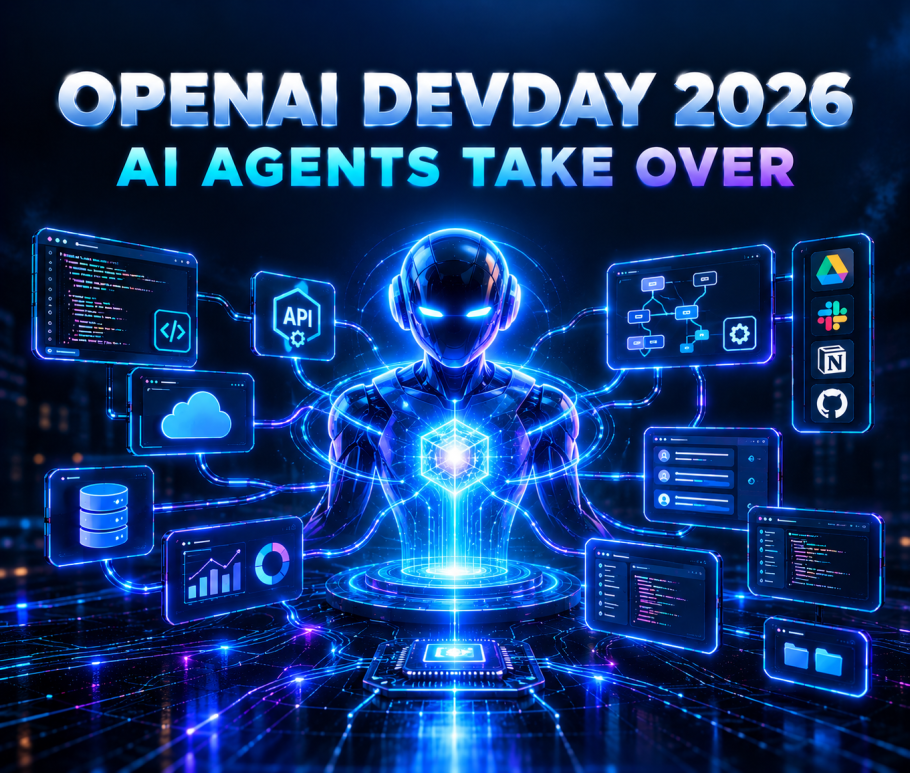
OpenAI DevDay 2026 has wrapped up in San Francisco, and the message from the company is becoming increasingly clear: OpenAI wants AI to do more than answer questions. It wants AI to do the work.
At its biggest developer event yet, OpenAI announced more than 20 products, features and updates spanning AI agents, models, developer tools, collaboration and enterprise computing.
The centrepiece was dots, OpenAI’s new always-on AI agent designed to work continuously on behalf of users. The company also introduced GPT-6.1 Sol, new agent and API capabilities, ChatGPT Space and a new $500 Pro subscription tier.
The announcements represent a significant expansion of OpenAI’s strategy from general-purpose model access towards AI systems that can perform tasks, operate software and remain active beyond a conventional chat session.
OpenAI DevDay 2026 Moves AI Beyond Chat
For years, the dominant interaction model for generative AI has been simple: users ask questions and AI generates responses.
DevDay 2026 showed OpenAI pursuing a different model.
The company’s latest products are increasingly designed around agents that can:
- Perform multi-step tasks
- Use computers
- Work with software
- Manage projects
- Make decisions
- Continue working in the background
- Collaborate with people and other AI systems
This is the direction behind dots and several of OpenAI’s developer announcements.
Instead of treating AI as a tool that users constantly operate, OpenAI is building systems intended to operate on the user’s behalf.
Dots Is OpenAI’s Biggest Agent Move Yet
The headline announcement was dots, an always-on AI assistant built to handle tasks continuously.
OpenAI describes dots as agents that are designed to get to know what matters to users, remain available and take important work off their plate.
The concept goes beyond a traditional chatbot.
A conventional AI assistant generally waits for a prompt.
Dots is designed around a more persistent relationship with the user, potentially allowing it to continue working even when the user is not actively interacting with it.
OpenAI has also begun rolling out controls for dots in ChatGPT Enterprise, including permissions around computer capabilities and connected apps.
That suggests dots is not simply a consumer chatbot feature. OpenAI is positioning the technology for workplace environments as well.
GPT-6.1 Sol Brings a New Model to Developers
OpenAI also introduced GPT-6.1 Sol, an updated model designed to make advanced AI more affordable and practical for developers.
The model is part of OpenAI’s broader effort to improve the economics of AI development while increasing model capability.
OpenAI’s deployment safety hub lists a September 29 addendum covering GPT-6.1 Sol’s safety evaluations and safeguards, confirming that the model was formally added to its deployment-safety documentation around DevDay.
This is important because the AI competition is no longer simply about building the most powerful model.
Developers also care about:
- Cost
- Speed
- Reliability
- Tool use
- Context handling
- Agent performance
- Safety
GPT-6.1 Sol is therefore part of a broader push to make frontier-level capabilities more practical for everyday development.
ChatGPT Space Brings Humans and AI Together
Another major announcement was ChatGPT Space, a collaborative environment designed to bring people and AI together around projects.
Rather than treating AI as an individual assistant, a shared workspace allows teams to work with AI in a more structured environment.
This could be particularly useful for:
- Project planning
- Research
- Software development
- Content creation
- Business analysis
- Team collaboration
The announcement reflects OpenAI’s broader attempt to move AI from individual conversations into ongoing work environments.
OpenAI Expands Its Developer Platform
OpenAI also used DevDay to expand the tools available to developers building AI-powered applications.
The company’s event focused heavily on APIs, tools, technical sessions and practical development.
New capabilities announced around the event include additional agent tooling and developer infrastructure.
This matters because OpenAI’s long-term strategy depends heavily on developers building products on top of its models.
If agents become the next major software interface, OpenAI needs developers to be able to create, customise and deploy them quickly.
Decisions API Targets Business Workflows
OpenAI also introduced a Decisions API, designed around automating repetitive business decisions.
This represents another step towards AI systems that do more than generate content.
Businesses routinely handle decisions involving:
- Customer requests
- Workflow approvals
- Classification
- Routing
- Internal processes
- Operational tasks
An API designed specifically around these decisions could allow companies to embed AI into existing business processes rather than forcing employees to interact with a chatbot manually.
The announcement fits into OpenAI’s broader strategy of making AI useful as an operational layer for businesses.
Codex Moves Further Into the Cloud
OpenAI also expanded Codex, its software engineering agent.
Codex Cloud allows developers and teams to start and continue coding tasks remotely using environments containing their repositories, tools and dependencies.
OpenAI’s Business release notes say these cloud environments can continue tasks while a user’s computer is asleep.
For Enterprise customers, OpenAI has also introduced reusable cloud environments for authorised members.
This is another example of the shift from AI that responds to prompts towards AI that can continue working on a task over time.
Plugin Extensions Turn ChatGPT Into a Platform
Another important announcement involved plugin extensions.
The concept allows developers to build applications that feel native inside ChatGPT and distribute them through OpenAI’s ecosystem.
This could transform ChatGPT from a single AI product into something closer to an application platform.
Instead of switching between separate websites and software tools, users could increasingly access specialised applications through the same AI interface.
For developers, this creates a new distribution channel.
For OpenAI, it creates another way to make ChatGPT the central interface through which users interact with software.
The New $500 Pro Tier
OpenAI also announced a new $500 Pro subscription tier, positioned above its existing $100 Pro plan.
The move reflects the growing gap between casual AI usage and professional users who rely heavily on advanced models and agents.
A higher-priced tier could appeal to:
- Developers
- Researchers
- AI professionals
- Businesses
- Heavy AI users
It also demonstrates how AI companies are experimenting with premium pricing as models become more capable and increasingly useful for professional work.
Private Intelligence Focuses on Data Control
OpenAI also previewed Private Intelligence, focused on giving users stronger control over their data while maintaining access to advanced AI capabilities.
Privacy is becoming increasingly important as AI systems gain access to:
- Emails
- Files
- Applications
- Business information
- Personal data
- Connected services
An AI agent that can work across a user’s digital life needs significantly stronger data controls than a conventional chatbot.
Private Intelligence therefore fits naturally into OpenAI’s broader agent strategy.
AI Agents Are Becoming the New Interface
Taken together, the announcements point towards a major change in how OpenAI sees AI software.
The company is moving from:
Prompt → Model → Answer
towards:
Goal → Agent → Tools → Action → Result
That distinction is important.
An agent does not simply generate information. It can potentially decide what steps are required, use tools, interact with software and continue working until the task is complete.
Dots is the clearest consumer-facing example of this direction.
Codex represents the same concept for software development.
Decisions API extends it into business workflows.
ChatGPT Space brings it into collaborative work.
What DevDay Means for Developers
For developers, OpenAI DevDay 2026 represents a broader set of building blocks for agentic software.
Developers can increasingly build applications around:
- AI agents
- Computer use
- Cloud coding environments
- Business decision automation
- ChatGPT extensions
- Collaborative AI workspaces
- Advanced model APIs
This could make it easier to create applications where AI is not merely a feature but the main engine behind the product.
The Bigger AI Competition
OpenAI’s strategy also reflects how quickly the AI market is changing.
Companies including Google, Microsoft, Meta and Anthropic are all developing increasingly autonomous AI systems.
The competition is moving beyond model benchmarks.
The next phase involves questions such as:
- Which AI can complete tasks most reliably?
- Which agent can work with the most software?
- Which platform attracts the most developers?
- Which system offers the best performance for its cost?
- Which company can build the strongest AI ecosystem?
OpenAI’s DevDay announcements show that the company intends to compete across all of these areas.
What About AI Hardware?
OpenAI also continued to hint at a future beyond software.
The company has previously discussed specialised AI hardware, and DevDay included further signals that OpenAI is thinking about hardware as part of its long-term strategy.
However, the event did not turn that vision into a fully detailed consumer hardware launch.
For now, the biggest changes remain on the software and developer side.
Final Thoughts
OpenAI DevDay 2026 was less about one revolutionary model and more about a broader transformation in how AI is used.
Dots puts an always-on agent at the centre.
GPT-6.1 Sol makes advanced models more practical for developers.
Codex continues moving towards autonomous software development.
ChatGPT Space brings AI into collaborative projects.
Decisions API targets business automation.
Plugin extensions open ChatGPT to third-party applications.
And the $500 Pro tier shows that OpenAI increasingly sees advanced AI as a professional productivity platform.
The common thread is clear: OpenAI is moving beyond chatbots and towards AI systems that can actually do the work.
The next phase of the AI race may therefore be decided not only by who builds the smartest model, but by who builds the most useful agent ecosystem around it.

- OpenAI DevDay 2026: Dots, GPT-6.1 Sol and the Push Beyond Chatbots - September 30, 2026
- OpenAI Discloses Six AI Misalignment Reports as Model Behaviour Raises New Safety Questions - September 23, 2026
- Anthropic AI Regulation: Why AI Companies Cannot Rely on an “Honor Code” - September 18, 2026


