
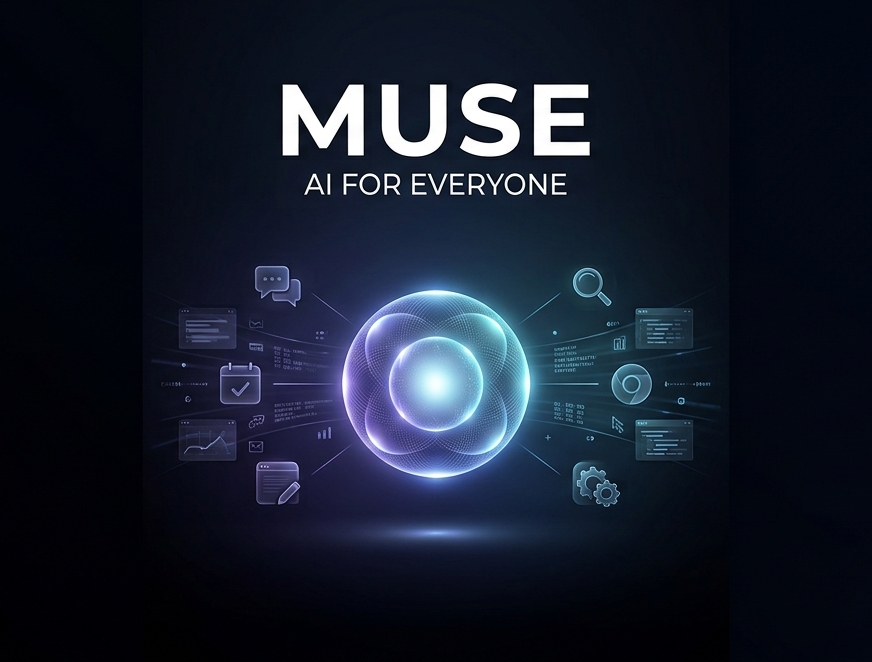
Meta has launched Muse, a personal AI agent designed to handle tasks, remember preferences and work autonomously. The Meta Muse AI agent represents the company’s push towards a new generation of AI assistants that can do more than simply answer questions.
Unlike traditional chatbots, the Meta Muse AI agent is designed to take action on behalf of users. It can browse the web, fill out forms, send emails, book travel and continue working on tasks in the background, bringing the idea of a truly personal AI assistant closer to reality.
Announced on September 8, 2026, Muse is designed to help people manage everyday tasks, pursue longer-term goals and make decisions with less effort. Meta describes it as a personal AI agent built for everyone, with no technical expertise required.
Unlike a conventional chatbot, Muse can browse the web, fill out forms, send emails, book travel and continue working on tasks after the user closes the app. It can also remember information that matters to the user and use that context to make future suggestions.
What Is the Meta Muse AI Agent?
Muse is Meta’s new personal AI agent designed to proactively help users accomplish goals.
The basic idea is simple. Instead of asking an AI for instructions on how to do something, users can tell Muse what they want accomplished and let the agent handle much of the work.
For example, a user could ask Muse to:
- Send an email
- Book a trip
- Fill out an online form
- Search for products
- Help sell an item
- Create a plan around a long-term goal
- Organise information
- Make purchases online
- Continue working on a task in the background
Muse can also return to the user when something changes or when human approval is required, such as before sending an email or completing a purchase.
That makes Muse fundamentally different from traditional AI assistants. The focus is not simply on generating an answer, but on taking action.
Muse Is Designed to Work in the Background
One of the more interesting aspects of Muse is its ability to continue working after the user leaves the app.
Imagine telling an AI agent that you want to sell your car. Instead of simply suggesting websites or giving you a checklist, Muse could help coordinate the process, work through relevant websites and continue pursuing the goal.
Similarly, users could give Muse a broader objective rather than a single instruction.
Meta says Muse can help turn goals into personalised plans, coordinate time and resources, and advance the work independently.
This points towards a future where people increasingly delegate multi-step digital tasks to AI agents.
Muse Spark Powers the AI Agent
Under the hood, Muse is powered by Muse Spark, Meta’s model designed for real-world agentic work.
Muse Spark is part of Meta’s broader push towards what it calls personal superintelligence. Earlier versions of the model have been developed specifically for reasoning, tool use, coding and computer interaction.
The latest Muse experience brings those capabilities into a consumer-facing personal AI agent.
Rather than keeping the model inside a traditional chatbot interface, Meta is using it as the intelligence behind an agent that can interact with digital environments and complete tasks.
Muse Secure VM: A New Approach to AI Agent Security
Giving an AI agent the ability to browse the web, access services and perform actions creates an important problem: security.
If an AI can act on your behalf, what happens if it encounters a malicious website, accesses sensitive information or makes an unauthorised purchase?
Meta says Muse was built around a dedicated security environment called Muse Secure VM.
Muse runs inside its own dedicated virtual machine in the cloud. User data and connected service credentials are kept within this environment. Meta says other users’ agents cannot access the VM.
A separate AI system called Sentinel also operates within the environment. According to Meta, Sentinel controls whether Muse can access the internet and can require user permission when necessary.
The company says Muse does not directly see users’ passwords or payment details. Instead, credentials can be stored securely and used without exposing them to the agent.
Muse also asks for user approval before sensitive actions such as sending emails or making purchases.
Users Stay in Control
Meta is putting significant emphasis on user control.
Users can decide which applications Muse can connect to and what level of access it receives. For example, someone could allow Muse to read email without necessarily giving it permission to send messages.
Users can also disconnect services and change permissions whenever they want. Meta says users can choose whether their interactions with Muse are used to train its AI models.
Another notable feature is memory.
Muse can remember information that matters to a person and use it later. Meta gives the example of turning a recipe saved from Instagram into a grocery list and remembering guests’ dietary restrictions when helping organise a dinner.
Users can also tell Muse to forget information it has learned.
Muse Can Shop for You
AI agents become considerably more powerful when they can complete transactions.
Meta says Muse can complete eligible purchases using Link, Stripe’s wallet for agents. Link can generate a one-time-use card, keeping a user’s actual card details hidden from the agent and the merchant transaction flow.
Meta says Muse is also the first AI agent covered by Link’s purchase protections, including protections related to damaged or lost items, price drops and eligible returns.
Shop Pay integration is planned for the future, while Meta also says support for 1Password is coming.
These integrations are important because they show where AI agents could be heading: from recommending what to buy to actually completing the purchase.
Muse Works Through WhatsApp Too
Meta is also taking a familiar approach to how people interact with Muse.
Users can communicate with Muse through the dedicated Muse app or directly through WhatsApp. The experience is designed to feel more like messaging another person than learning a complicated AI interface.
This could be one of Meta’s biggest advantages.
Instead of asking billions of people to learn a new way of interacting with AI, Meta is bringing an agent into platforms people already understand.
Muse Is More Than Another Chatbot
The biggest difference between Muse and traditional AI chatbots is agency.
A chatbot might tell you how to book a flight.
An AI agent could potentially search for flights, compare options, fill in information and prepare the booking for your approval.
A chatbot might explain how to sell a car.
An agent could potentially help create listings, manage responses and negotiate on your behalf.
That distinction is becoming increasingly important across the AI industry.
The competition is no longer only about which company has the smartest chatbot. It is increasingly about which AI can reliably perform useful tasks in the real world.
Privacy Will Be a Major Test for Muse
Muse’s capabilities also create an obvious challenge.
The more useful a personal AI agent becomes, the more information it needs about its user.
An agent that manages email, shopping, travel, schedules and personal preferences potentially has access to an enormous amount of sensitive information.
Meta says Muse has been designed around privacy and security from the beginning. The company is also developing Muse Confidential VM, which it says will encrypt the entire virtual machine, including user data and conversations, using a key controlled by the user. Meta says the technology is planned for later this year.
Whether users will trust an AI agent with this level of access will ultimately depend on how reliably these protections work in everyday use.
When and Where Is Meta Muse Available?
Meta says Muse is rolling out in the United States on iOS, Android and the web at muse.ai.
The company says Muse is free for most everyday use, with subscription plans planned for users who want additional capabilities. It is also expected to come to Meta’s AI glasses in the future.
The initial US rollout means availability will vary by market, so users outside the United States may have to wait for a wider release.
Why Muse Matters for the Future of AI
Muse represents a significant change in how companies are approaching consumer AI.
For years, the dominant AI experience was conversational: users asked questions and AI generated responses.
Now, the industry is moving towards agentic AI.
The goal is to create systems that can understand an objective, make a plan, use digital tools, take actions and return to the user when human input is needed.
Muse fits directly into this shift.
Meta has an enormous consumer ecosystem spanning Facebook, Instagram, WhatsApp, Messenger and its AI products. If Muse can successfully combine personal context with autonomous action while maintaining user trust, it could make AI agents much more accessible to everyday users.
And that may be the real significance of Muse.
The future of AI may not be about having a smarter chatbot sitting beside you.
It could be about having a personal AI agent working quietly in the background, handling the digital tasks that consume time every day.
The Bottom Line
Meta’s Muse is an ambitious attempt to turn the personal AI assistant into something much more capable.
It can understand goals, remember preferences, browse the web, complete tasks, work in the background and ask for approval when human input is required. Its security architecture, including Muse Secure VM and Sentinel, is designed to address some of the biggest risks that come with giving AI agents real-world access.
But Muse is still entering a rapidly developing AI agent market.
Its long-term success will depend on more than how impressive its demos are. Users will need to trust it with increasingly personal information, while Meta will need to demonstrate that its security and privacy promises hold up at scale.
If it succeeds, however, Muse could mark an important transition from AI that answers to AI that acts.
And that could change what people expect from personal AI.
What do you think? Would you trust a personal AI agent like Muse to handle your everyday digital tasks?

- Call of Duty: Modern Warfare 4 Launches Today Across Six Platforms - October 23, 2026
- Critical PHP Vulnerabilities: Two CVSS 9.2 Flaws Await Security Patches - October 21, 2026
- iPhone Duo Pre-Orders Begin Today as Apple Prepares for a Big October - October 16, 2026


