
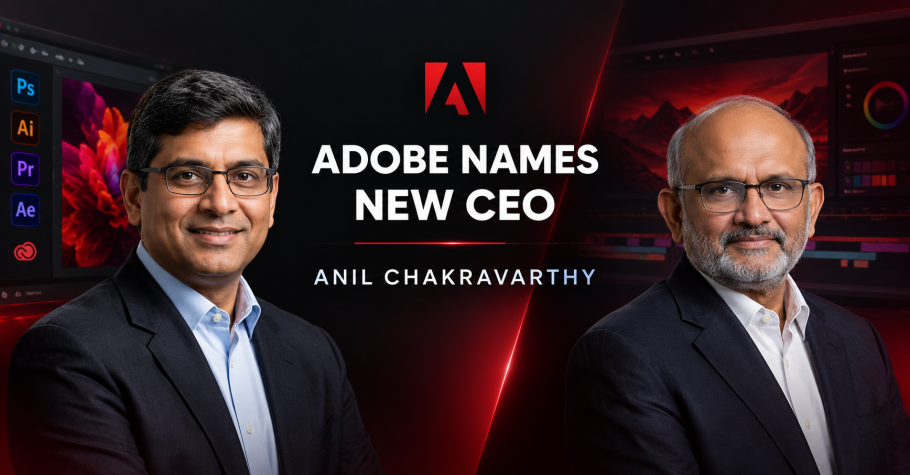
Adobe is preparing for a major leadership transition as Anil Chakravarthy becomes the company’s next president and CEO.
Adobe announced on September 3, 2026, that Chakravarthy will become president and CEO and join the company’s board of directors effective December 1, 2026. Current CEO Shantanu Narayen will transition to the role of executive chair.
The leadership change comes at an important moment for Adobe.
The company is navigating a rapidly changing creative software market, where artificial intelligence is transforming how people create images, videos, documents and digital experiences.
Adobe has invested heavily in generative AI through products such as Firefly, while competitors and AI-native platforms continue to challenge traditional creative workflows.
The appointment of Chakravarthy therefore represents more than a change at the top. It could also signal the direction Adobe wants to take as AI becomes increasingly central to its products and business.
Who Is Anil Chakravarthy?
Anil Chakravarthy is not an outsider joining Adobe for the first time.
He has been with Adobe since 2020 and currently serves as president of the company’s Customer Experience Orchestration business and worldwide field operations. Adobe says he has spent the past six and a half years expanding and transforming that business through innovation-led growth.
Before joining Adobe, Chakravarthy was the CEO of enterprise data management company Informatica.
He has also held leadership positions at companies including Symantec and VeriSign and previously worked at McKinsey & Company, according to Reuters.
His background is particularly relevant to Adobe’s current strategy because the company is no longer focused solely on creative applications.
Adobe increasingly operates across creative software, digital documents, marketing technology, customer experience and data-driven digital experiences.
Chakravarthy’s experience across enterprise software and data could therefore become increasingly valuable as Adobe builds AI into those areas.
Shantanu Narayen’s Adobe Legacy
Shantanu Narayen has led Adobe as CEO for more than 18 years.
During his tenure, Adobe underwent one of the biggest transformations in its history.
The company moved from a traditional software licensing model towards a subscription-based cloud business built around products such as Creative Cloud, Document Cloud and Experience Cloud.
Narayen also oversaw Adobe’s expansion beyond traditional creative software.
Today, Adobe’s ecosystem covers areas including:
- Digital creativity
- Video production
- Document management
- Digital marketing
- Customer experience
- Generative AI
- Enterprise content workflows
Narayen’s next role as executive chair means he is not leaving Adobe altogether.
Instead, he will work with Chakravarthy to support the leadership transition and Adobe’s ongoing transformation.
Why Adobe Is Making the Change Now
The leadership transition comes at a critical point for the software industry.
Generative AI is changing how creative work is produced.
Tools that once required specialised software knowledge can now be accessed through natural-language prompts and AI-assisted workflows.
Image generation, video creation, design assistance, content editing and document processing are all becoming increasingly AI-powered.
Adobe has responded with its Firefly family of generative AI technologies and AI features across its product portfolio.
But the competitive environment is becoming more difficult.
AI-native companies and established competitors are introducing increasingly capable creative tools, while platforms such as Canva and Figma continue to compete for users and businesses. Reuters reported that Adobe is navigating these pressures alongside investor concerns about AI’s potential impact on its traditional software business.
That makes the CEO transition particularly significant.
Adobe’s AI Strategy Is Becoming More Important
Adobe has been positioning AI as an enhancement to its existing creative ecosystem rather than simply replacing professional creative software.
The company’s Firefly technology is designed to bring generative AI capabilities directly into creative workflows.
Instead of moving between separate AI tools and professional applications, users can increasingly access AI features within Adobe’s ecosystem.
This strategy gives Adobe an important advantage.
The company already has millions of creative professionals and businesses using products such as Photoshop, Illustrator, Premiere Pro and Acrobat.
The challenge is turning that existing customer base into an advantage in an AI-first market.
Chakravarthy will now be responsible for helping Adobe navigate that transition.
From Creative Software to AI-Powered Experience
Adobe’s business has expanded significantly beyond Photoshop and Illustrator.
The company has increasingly positioned itself as a platform covering the entire content lifecycle.
That includes creating content, managing it, distributing it, measuring engagement and delivering personalised digital experiences.
This broader strategy could become even more important under Chakravarthy.
His current role leading Customer Experience Orchestration gives him experience across a part of Adobe’s business that sits beyond traditional creative applications.
It also connects closely with Adobe’s wider push towards AI-powered customer experiences.
Adobe has already been introducing agentic capabilities designed to automate complex customer experience workflows. Its newsroom, for example, highlighted the company’s CX Enterprise Coworker for building agentic-enabled workflows in 2026.
AI Could Reshape Adobe’s Creative Business
The biggest question for Chakravarthy may be how Adobe monetises AI without undermining the value of its existing products.
AI can make certain creative tasks dramatically faster.
A designer can generate variations of an image in seconds.
A marketer can create multiple versions of campaign content.
A video editor can use AI to accelerate editing and production.
A business user can work with documents using natural-language commands.
These improvements can increase the value of Adobe’s software.
But they can also lower the technical barrier to creating content.
That creates opportunities for new competitors.
Adobe therefore needs to ensure that AI makes Creative Cloud and its broader ecosystem more valuable rather than making professional software less necessary.
Adobe Faces Growing Competition
Adobe’s leadership transition comes as competition in creative technology intensifies.
Companies such as Canva and Figma have built strong positions around collaborative, browser-based and increasingly AI-assisted design workflows.
At the same time, generative AI companies are making image, video and design generation accessible through standalone applications and APIs.
This means Adobe is competing on multiple fronts.
It needs to maintain its position among professional creatives while also attracting a new generation of users who increasingly expect AI-first interfaces.
The company also needs to convince enterprise customers that Adobe’s integrated ecosystem offers more value than assembling a collection of specialised AI tools.
Chakravarthy’s Informatica Experience Could Matter
One of the most interesting aspects of Chakravarthy’s appointment is his previous experience at Informatica.
Informatica is closely associated with enterprise data management, cloud data integration and data governance.
That experience could be relevant as AI becomes more dependent on high-quality enterprise data.
Businesses increasingly want AI systems that can work with internal information while maintaining security, governance and compliance.
Adobe’s enterprise customers face similar challenges.
AI-powered customer experiences require organisations to connect content, customer data and business workflows.
Chakravarthy’s background therefore fits into a broader shift at Adobe from being primarily a creative software company towards being an AI-powered enterprise technology platform.
What Happens to Shantanu Narayen?
Narayen’s move to executive chair is also significant.
Rather than completely stepping away, he will remain involved in Adobe’s strategic direction and work with Chakravarthy during the transition.
Adobe says Narayen will support the company as it continues its transformation.
This could provide continuity while giving the incoming CEO room to shape the next stage of Adobe’s strategy.
Narayen’s long tenure also means he has deep knowledge of Adobe’s products, customers and business model.
That experience could be valuable as the company navigates a period of significant technological change.
What This Means for Adobe Users
For everyday Adobe users, the leadership change is unlikely to produce an immediate dramatic difference.
Photoshop, Illustrator, Premiere Pro, Acrobat and other Adobe products will continue to evolve.
The bigger changes will likely emerge gradually through AI-powered features and new workflows.
Users can expect Adobe to continue investing in areas such as:
- Generative AI
- AI-assisted design
- AI video creation
- Automated content production
- Intelligent document workflows
- AI-powered customer experiences
- Agentic workflows
The company is likely to place even greater emphasis on connecting these capabilities across its ecosystem.
What This Means for Adobe’s Future
The appointment of Anil Chakravarthy as Adobe CEO comes at a defining moment for the company.
Adobe successfully navigated previous technology shifts, including the move from desktop software to cloud subscriptions.
Now it faces another major transformation.
AI is changing not only how software works but also who can create digital content and how quickly that content can be produced.
Adobe’s challenge is to remain essential in that new environment.
Chakravarthy’s combination of Adobe experience, enterprise software expertise and data-industry background could help the company make that transition.
At the same time, the continued involvement of Narayen as executive chair provides an element of strategic continuity.
Final Thoughts
Adobe is entering a new chapter.
Anil Chakravarthy will become Adobe’s president and CEO on December 1, 2026, replacing Shantanu Narayen, who will move into the role of executive chair.
The timing is significant.
Adobe is competing in a market where AI is rapidly changing creative software, enterprise workflows and customer experiences.
Chakravarthy inherits a powerful global software ecosystem, but he also faces the challenge of ensuring Adobe remains indispensable in an increasingly AI-first world.
His previous experience at Informatica and his leadership of Adobe’s customer experience business could prove important as the company expands beyond traditional creative software.
For Adobe, the next chapter will not simply be about who leads the company.
It will be about whether Adobe can turn AI from a disruptive force into the foundation of its next generation of products.

- AI-Powered Cyberattacks: Hacker Breaches 100+ Websites for $5,000 - October 20, 2026
- Reflection AI Beam Matches GLM-5.2-Level Performance With 3 to 4x Less Compute - October 7, 2026
- Google Sends AI Chips Into Space as Project Suncatcher Moves Toward Orbital Compute - September 25, 2026


