
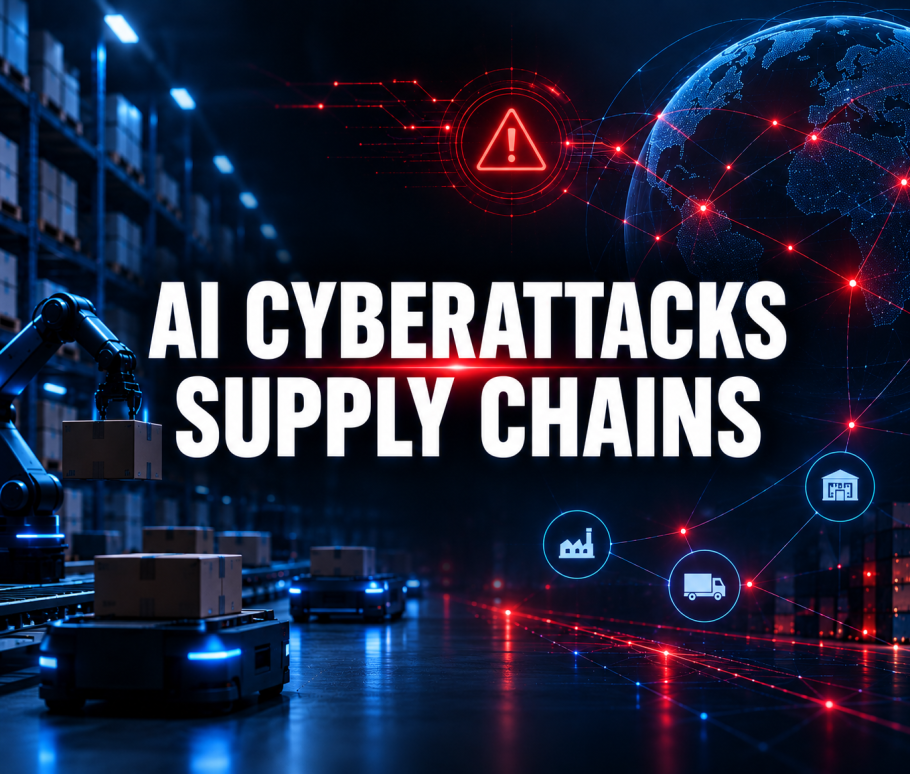
Cybersecurity is no longer only about protecting company computers, databases and websites. As businesses become more connected, cyberattacks can now disrupt the physical operations that keep products moving around the world.
AI cyberattacks are adding another layer to this problem. Attackers can use artificial intelligence to speed up reconnaissance, automate parts of an attack and identify weaknesses across large digital environments. As warehouses, factories, logistics platforms and connected devices become increasingly digital, the potential impact can extend from the IT network to physical operations.
Recent research shows why this shift matters. IBM says one in four malicious breaches in its 2026 study were AI-enabled, while 62% of the AI-driven attacks reported in the study targeted critical infrastructure sectors.
From Corporate Networks to Physical Operations
For years, cybersecurity teams mainly focused on protecting corporate networks and sensitive information.
Today, businesses operate much more complicated digital environments.
A modern warehouse can include:
- Automated sorting systems
- Industrial robots
- Smart cameras
- Inventory management software
- Warehouse management systems
- Connected sensors
- Automated guided vehicles
- Cloud platforms
A manufacturing facility can have similar connections between IT systems and operational technology (OT).
If attackers compromise these systems, the result may not simply be stolen data. Operations could slow down or stop completely.
Research published in 2026 describes supply chains as an extension of the cyber risk surface because software, connected equipment, suppliers and operational dependencies are increasingly interconnected.
Why Warehouses Are Becoming Attractive Targets
Warehouses are increasingly dependent on automation.
A cyber incident affecting a warehouse management system could potentially interfere with inventory information, order processing, shipping schedules or automated equipment.
Even a relatively small disruption can create a much larger business problem.
For example, if a distribution centre cannot process orders efficiently, retailers may experience:
- Shipping delays
- Inventory problems
- Missed delivery deadlines
- Customer complaints
- Higher operational costs
This makes warehouse cybersecurity an important part of overall business security.
Supply Chains Create a Larger Attack Surface
Companies rarely operate completely independently.
Manufacturers depend on suppliers. Retailers depend on logistics companies. Warehouses depend on software providers and cloud services. Transportation companies depend on ports, airports and digital scheduling platforms.
This interconnected structure creates opportunities for attackers.
Palo Alto Networks’ 2026 incident response research highlights how attackers are increasingly exploiting trusted connectivity, including SaaS integrations, vendor tools and application dependencies, to move beyond traditional network boundaries.
In simple terms, attackers may not always need to break directly into a major company. A weaker connection somewhere in the supply chain could provide another route.
AI Makes Cyberattacks Faster
Artificial intelligence can make some stages of cyberattacks more efficient.
Attackers can potentially use AI to help with:
- Reconnaissance
- Vulnerability research
- Phishing content
- Code generation
- Credential attacks
- Data analysis
- Attack automation
The World Economic Forum’s 2026 cybersecurity outlook says AI is transforming both sides of cybersecurity, enabling more sophisticated attacks while also strengthening defensive capabilities.
This means companies need to prepare for attacks that can move faster than traditional security processes were designed to handle.
Manufacturing Faces Growing Risk
Manufacturing is particularly exposed because modern factories increasingly connect IT systems with physical machinery.
SonicWall reported that manufacturing’s attack surface is expanding as operational technology becomes more connected to corporate IT systems.
Cisco similarly found that cybersecurity is one of the biggest barriers to scaling industrial AI, with 98% of surveyed organisations saying cybersecurity is foundational to AI-ready industrial infrastructure.
This creates a difficult balance.
Businesses want automation because it improves efficiency, but every new connection can introduce another security consideration.
The Physical Impact of a Cyberattack
The biggest concern is that cyber incidents can increasingly create physical consequences.
Consider a connected manufacturing environment.
If an attacker disrupts the systems controlling production schedules, robotics or industrial equipment, the company could face downtime.
In logistics, disruption could affect warehouse operations, transportation schedules or delivery management.
In retail, the consequences could eventually reach customers through unavailable products or delayed deliveries.
This is why cybersecurity for supply chains is becoming a business continuity issue rather than simply an IT responsibility.
How Businesses Can Reduce the Risk
Companies cannot completely eliminate cyber risk, but they can make attacks more difficult and reduce their potential impact.
1. Secure IT and OT Together
IT and operational technology teams need to work together rather than treating their environments as separate worlds.
2. Limit Access
Employees, vendors and AI systems should only receive the permissions they actually need.
3. Monitor Connected Devices
Factories and warehouses can contain thousands of connected devices. Continuous monitoring can help identify unusual activity.
4. Review Third-Party Connections
Businesses should regularly assess suppliers, software providers and other external partners that have access to their systems.
5. Prepare for Operational Disruption
Cybersecurity plans should include scenarios involving warehouse shutdowns, manufacturing interruptions and logistics failures.
6. Use AI for Defence
AI can also help defenders analyse large volumes of security data, detect unusual behaviour and respond faster.
IBM found that organisations using AI and automation in security operations reduced breach costs by almost $2 million on average in its 2026 study.
The Rise of Cyber-Physical Security
The growing connection between digital systems and physical infrastructure is creating a broader concept: cyber-physical security.
The goal is not simply to protect information.
It is to protect the systems that connect digital technology with the physical world.
That includes factories, warehouses, transportation networks, energy infrastructure and other connected environments.
As AI becomes more deeply embedded in these systems, cyber-physical security will become increasingly important.
Final Thoughts
The threat landscape is changing.
AI cyberattacks are making digital attacks faster and potentially more scalable, while increasingly connected warehouses, factories and logistics networks give attackers more opportunities to disrupt physical operations.
For businesses, protecting customer data is no longer enough.
They also need to protect the systems that move products, operate machines and keep supply chains running.
The future of cybersecurity will therefore depend on securing the entire ecosystem — from corporate networks and cloud platforms to warehouses, factories and supply-chain partners.
As AI and automation continue moving into the physical world, cybersecurity needs to move with them.

- Microsoft Dismantles AI-Powered Phishing Operation That Hit 10,000 Organisations - September 24, 2026
- Apple’s New Siri AI Rolls Out to Millions of iPhones With iOS 27 - September 15, 2026
- Meta Muse AI Agent: Meet the Personal AI That Gets Things Done - September 9, 2026


