
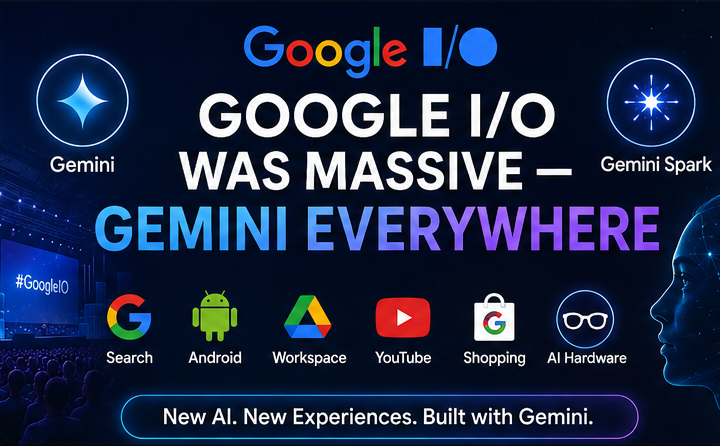
Google I/O 2026 made one thing very clear. Google is fully rebuilding its ecosystem around artificial intelligence. From Search and Android to Workspace, YouTube, shopping, and even wearable devices, Gemini AI is now at the center of almost everything Google does.
This year’s event was packed with announcements, but the biggest highlight was how deeply Gemini is now connected to Google products. Instead of AI being a separate tool, Google is turning AI into the core experience of its entire platform.
The company introduced several new AI technologies including Gemini 3.5 Flash, Gemini Omni, Gemini Spark, advanced AI coding assistants, AI generated interfaces, and Android XR smart glasses partnerships.
For tech lovers, developers, businesses, and regular users, Google I/O 2026 showed a future where AI works constantly in the background to make daily digital tasks easier, smarter, and faster.
Gemini 3.5 Flash Brings Faster AI Experiences
One of the major announcements was Gemini 3.5 Flash. Google designed this model to deliver quick AI responses with lower processing costs and better efficiency.
This means users can get faster AI powered results while using Google Search, Android apps, Gmail, Docs, and other Google services.
Gemini 3.5 Flash is especially useful for real time tasks like:
- Smart email replies
- Instant search summaries
- AI generated writing suggestions
- Faster chatbot conversations
- Live productivity assistance
Google is focusing heavily on speed because AI tools need to feel natural and immediate. Instead of waiting several seconds for answers, Gemini 3.5 Flash aims to provide near instant responses.
This move also helps developers who want to build AI powered apps without spending too much on computing resources.
Gemini Omni Expands Multimodal AI
Another exciting launch was Gemini Omni. This model can understand and process multiple types of content including:
- Text
- Images
- Video
- Voice
- Documents
This is called multimodal AI, and it allows Gemini to understand information more like humans do.
For example, users could upload a photo, ask questions about it using voice, and receive visual and text based answers instantly.
Google demonstrated how Gemini Omni can help with:
- Video analysis
- Live translation
- Smart presentations
- Interactive learning
- Visual shopping experiences
The goal is to create AI systems that can naturally interact with the world instead of only responding to typed questions.
Gemini Spark Is Google’s Big AI Agent Move
Perhaps the biggest talking point from Google I/O 2026 was Gemini Spark.
Google described Gemini Spark as an always on AI agent that can continuously work in the background. Unlike normal chatbots that only respond when asked, Gemini Spark is designed to proactively help users complete tasks.
This is Google’s strongest answer yet to the growing demand for agentic AI systems.
Gemini Spark can:
- Work across Google Workspace
- Connect with third party applications
- Assist with scheduling and organization
- Manage workflows automatically
- Eventually interact with local files on devices
Imagine an AI assistant that helps prepare meeting notes, organizes emails, creates summaries, updates calendars, and even coordinates work between multiple apps without constant user instructions.
That is the direction Google is heading.
For businesses, this could significantly improve productivity. For regular users, it may simplify daily digital life.
Google Workspace Gets Smarter With AI
Google is also deeply integrating Gemini into Google Workspace.
Apps like Gmail, Docs, Sheets, Meet, and Slides are receiving stronger AI features powered by Gemini.
Some of the new capabilities include:
- AI generated meeting summaries
- Automatic email drafting
- Smart spreadsheet analysis
- AI presentation design
- Real time collaboration support
Instead of manually handling repetitive work, users can rely on Gemini to assist with routine tasks.
This is especially valuable for remote teams, startups, students, and business professionals who want to save time.
Google is clearly competing directly with other AI productivity platforms by making Workspace more intelligent and automated.
Android XR Glasses Show Google’s Hardware Vision
Google also revealed new Android XR glasses partnerships with companies like Samsung and Warby Parker.
These smart glasses are designed to combine augmented reality with Gemini AI.
The idea is simple. Users can wear lightweight smart glasses and receive real time AI assistance directly in their field of view.
Potential use cases include:
- Navigation assistance
- Live translation
- Instant search results
- Smart notifications
- Visual AI guidance
Google believes wearable AI devices could become the next major computing platform after smartphones.
The partnerships with fashion focused companies like Warby Parker also show that Google wants these devices to look stylish and practical for everyday use.
AI Coding Tools Continue to Grow
Google also introduced new AI coding tools designed for developers.
These tools can help programmers:
- Write code faster
- Detect errors automatically
- Generate app interfaces
- Explain complex code
- Improve debugging
AI coding assistants are becoming one of the fastest growing areas in the technology industry.
By integrating Gemini into software development workflows, Google hopes to attract more developers into its ecosystem.
This could make app creation faster and easier, even for beginners.
AI Generated Interfaces Could Change App Design
Another interesting concept introduced at Google I/O 2026 was AI generated interfaces.
Instead of manually designing every screen, future apps may dynamically create layouts based on user behavior and needs.
For example, an app could automatically adjust menus, buttons, and content presentation depending on what the user wants to achieve.
This creates more personalized digital experiences and could completely change how apps are built in the future.
What Google’s AI Strategy Really Means
The biggest takeaway from Google I/O 2026 is that Google no longer sees AI as an optional feature.
Gemini is becoming the foundation of Google’s entire product ecosystem.
Search, Android, Workspace, YouTube, shopping, hardware, and developer tools are all being redesigned around AI first experiences.
Google is competing aggressively in the AI race, especially against companies building advanced AI assistants and agentic systems.
With Gemini Spark, multimodal AI, wearable devices, and AI powered productivity tools, Google is positioning itself for a future where AI becomes a constant digital companion.
Final Thoughts
Google I/O 2026 was one of the most important AI focused events in recent years.
The announcements showed that Google is moving beyond simple chatbots and building a fully connected AI ecosystem powered by Gemini.
From Gemini Spark and Gemini Omni to Android XR glasses and AI coding tools, the company is investing heavily in making AI part of everyday life.
For users, this could mean smarter apps, better productivity, and more personalized digital experiences.
For businesses and developers, it opens new opportunities to build AI powered solutions faster than ever before.
One thing is certain. Gemini is no longer just another AI product. It is becoming the brain behind Google’s future.

- Amazon Drone Delivery to Reach Nearly 500 Cities - August 20, 2026
- Alibaba AI Models Hit 3 Billion Downloads, Overtaking Meta and Google - August 17, 2026
- Google Pixel 11 Unveiled With Gemini at the Centre of the AI Phone War - August 14, 2026


