
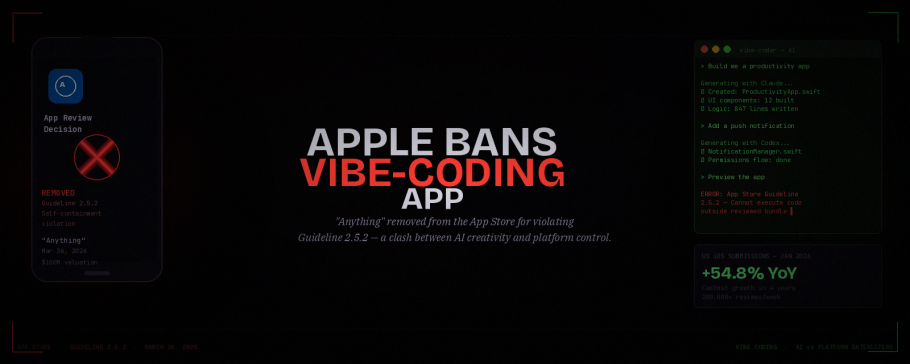
In March 2026, Apple removed the AI-powered vibe coding app Anything from the App Store, marking a major shift in how platform owners are responding to AI-driven software creation. What started as a fast-growing category enabling non-developers to build apps using natural language has now hit a regulatory wall.
The removal of Anything, which had raised $11 million and reached a $100 million valuation, signals more than just a policy enforcement. It highlights a growing tension between AI creativity and platform control.
What Is Vibe Coding and Why It Matters
Vibe coding refers to AI-assisted app development where users describe what they want, and the system generates functional applications. Tools like Anything, Replit, and Vibecode allow users to create apps without traditional coding skills, often powered by models like Claude and Codex.
This approach lowers the barrier to entry for software creation and accelerates innovation. However, it also challenges the traditional App Store model, where every app must go through a controlled review process.
Why Apple Removed the Anything App
Apple cited Guideline 2.5.2, which requires apps to be self-contained and prohibits downloading or executing new code that changes functionality after approval.
From Apple’s perspective, vibe coding apps violate this rule by acting as runtime environments. When users generate and run new apps within the platform, it effectively bypasses Apple’s review system.
Even though Anything attempted to comply by shifting previews to a browser-based experience, the update was rejected, and the app was removed entirely. This raises concerns about consistency and transparency in enforcement.
Inconsistent Enforcement Across AI App Builders
One of the biggest concerns in this situation is inconsistency. While Anything was removed, other tools like Replit and Vibecode remain on the App Store but cannot release updates. Meanwhile, similar platforms like Vercel’s v0 continue to operate without clear restrictions.
This creates uncertainty for developers. Compliance is no longer just about following documented rules, but also interpreting how those rules are applied in practice.
The Bigger Issue: Platform Control vs AI Innovation
Apple’s decision is not happening in isolation. It reflects a broader conflict between platform ecosystems and emerging AI capabilities.
Vibe coding tools can generate apps that operate outside the App Store, potentially bypassing Apple’s commission model. They also compete with Apple’s own development ecosystem, including Xcode and its growing AI integrations.
While Apple frames the ban as a security and quality control measure, critics argue it may also serve to protect its platform dominance.
Regulatory Implications and Industry Impact
The timing of this crackdown aligns with increased global scrutiny of app store practices. Regulations like the EU Digital Markets Act are already pushing for more openness in mobile ecosystems.
Blocking AI-powered development tools could attract further regulatory attention, especially if enforcement appears inconsistent or anti-competitive.
For developers, this creates a new reality. Building AI-powered tools for iOS now requires careful architectural decisions and legal awareness.
What Developers Should Do Next
For companies building in the AI app development space, the path forward is cautious but clear:
- Avoid executing AI-generated code within native iOS apps
- Use browser-based previews instead of in-app execution
- Consider web-first or cross-platform approaches
- Monitor Apple’s evolving policies closely
- Explore alternative distribution channels where possible
The Future of AI App Development
Apple’s ban on Anything marks a turning point. It shows that while AI is expanding what users can create, platform owners still control how that creation is distributed.
The tension between innovation and control will likely define the next phase of AI software development. Whether vibe coding evolves within platform rules or moves beyond them remains to be seen.
One thing is certain: AI is changing how software is built, and platforms will need to adapt just as quickly as developers do.

- Amazon Drone Delivery to Reach Nearly 500 Cities - August 20, 2026
- Alibaba AI Models Hit 3 Billion Downloads, Overtaking Meta and Google - August 17, 2026
- Google Pixel 11 Unveiled With Gemini at the Centre of the AI Phone War - August 14, 2026


