
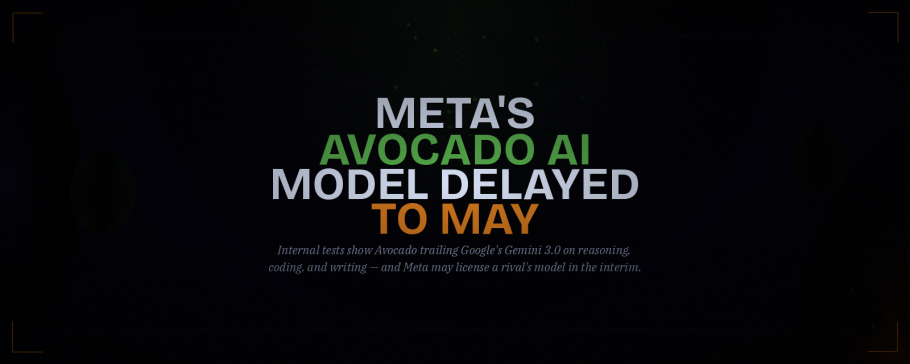
Meta’s next-generation AI system, the Meta Avocado AI Model, has reportedly been delayed from its expected March 2026 launch to May 2026 or later. The update signals the growing pressure among major tech companies competing to build the most advanced AI models.
The delay was first reported by major outlets including The New York Times and Reuters. According to these reports, internal testing showed that the Meta Avocado AI Model still trails the latest systems developed by companies like Google, OpenAI, and Anthropic.
While delays are common in frontier AI development, this update is significant because Meta has committed billions of dollars to AI research and promised major breakthroughs in 2026.
Why the Meta Avocado AI Model Was Delayed
Internal evaluations suggest that the Meta Avocado AI Model currently performs between Google’s Gemini 2.5 and Gemini 3.0 models in several benchmarks. This means it improves upon earlier Meta systems like Llama 4 but does not yet match the performance of the newest competitors.
Releasing a model that lags behind competitors could affect Meta’s credibility in the AI race. As a result, the company has decided to extend development time to improve reasoning, coding, and language capabilities.
For reference, Google’s Gemini model updates have already set strong benchmarks in AI performance.
The additional development time may help Meta close the gap before releasing the model publicly.
Reports of Meta Considering Google Gemini
Another major discussion inside Meta reportedly involves temporarily licensing Google’s Gemini AI technology to power some Meta products while Avocado continues development.
If implemented, this would be a notable shift in strategy.
For years, Meta has promoted open AI ecosystems through the Llama family of models, positioning them as alternatives to closed systems from companies like OpenAI and Google.
Using a competitor’s technology – even temporarily – could signal how competitive the AI landscape has become.
The Bigger AI Investment Behind Avocado
The Meta Avocado AI Model is being developed within Meta’s specialized AI research group sometimes referred to as TBD Lab, which includes several prominent AI leaders.
Meta also dramatically increased its AI spending. The company plans to invest $115–$135 billion in AI infrastructure and research in 2026, making it one of the largest AI investment commitments in the tech industry.
These investments aim to help Meta compete with leaders such as:
- OpenAI’s GPT models
- Google’s Gemini family
- Anthropic’s Claude AI systems
With so much capital committed, the Avocado model is expected to play a major role in demonstrating the return on that investment.
What the Delay Means for Meta’s AI Strategy
Although the delay may appear concerning, it also reflects the complexity of building frontier AI models.
Developing systems that can match or exceed competitors requires improvements in areas like:
- reasoning capabilities
- coding assistance
- multimodal understanding
- real-time performance
The Meta Avocado AI Model represents the company’s effort to move beyond its previous Llama models and build a more advanced platform for future AI products across Facebook, Instagram, and WhatsApp.
If the final release significantly improves benchmark performance, the delay could ultimately strengthen Meta’s position in the AI race.
What to Watch When Avocado Launches
When the Meta Avocado AI Model finally launches, several factors will determine its impact:
Benchmark performance
Will it compete with the latest Gemini and GPT models?
Open or closed release
Meta may choose to release the model under an open license like Llama or keep it proprietary.
Integration across Meta apps
The model could power AI assistants and features across Meta’s ecosystem.
Future models in development
Reports suggest additional AI models – including projects codenamed Mango and Watermelon—are also being developed.
Final Thoughts
The delay of the Meta Avocado AI Model highlights just how competitive the AI industry has become. Even companies with massive budgets, world-class researchers, and advanced infrastructure face challenges delivering frontier AI systems.
While the new release timeline pushes expectations to May 2026 or later, the extra development time could help Meta deliver a stronger model that better competes with the current leaders in artificial intelligence.
As the AI race continues, the launch of the Meta Avocado AI Model will be closely watched by developers, businesses, and the broader tech industry.