
Cyberattacks are evolving faster than ever. What once required skilled hackers and months of planning can now be executed quickly using automation and artificial intelligence.
According to the latest security analysis from Cloudflare, cybercrime has entered a new phase. The Cloudflare Threat Report 2026 highlights how attackers are using AI, massive botnets, and stolen credentials to launch attacks at unprecedented speed.
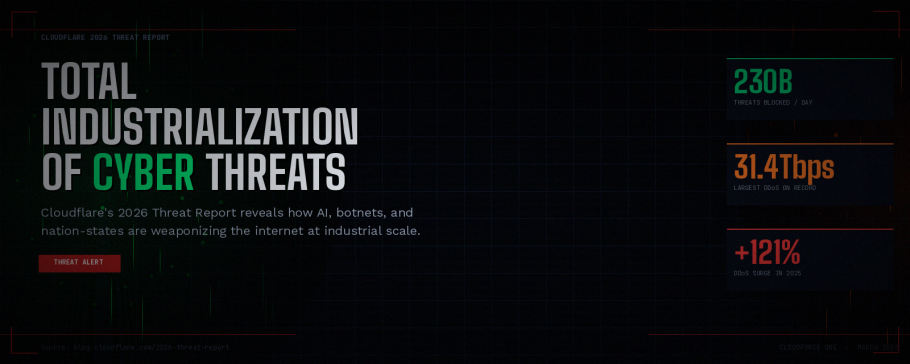
The report is based on data collected across Cloudflare’s global network, which blocks approximately 230 billion cyber threats every day. These findings reveal that businesses must rethink their cybersecurity strategies to keep up with the rapidly changing threat landscape.
AI Is Transforming Modern Cyberattacks
Artificial intelligence has dramatically lowered the barrier to cybercrime. In the past, hackers needed advanced technical skills to find vulnerabilities and exploit them. Today, AI tools can automate much of that work.
The Cloudflare report shows that attackers are now using AI to locate sensitive information across systems and extract it quickly.
In one incident highlighted in the report, attackers used AI to identify high-value data across multiple organizations and steal it automatically. The attack affected hundreds of companies and demonstrated how AI can scale cybercrime operations.
Nation-State Cyber Operations Are Increasing
Cyber activity linked to governments is also becoming more sophisticated. Groups associated with North Korea have reportedly used AI-generated deepfakes and synthetic identities to apply for remote jobs at technology companies.
Instead of hacking into systems directly, these actors gain legitimate access by working inside organizations.
Research from Verizon in its annual Data Breach Investigations Report shows that attackers increasingly target human vulnerabilities instead of technical ones.
DDoS Attacks Are Reaching Record Levels
Distributed Denial-of-Service attacks continue to grow in both size and frequency.
Cloudflare reported 47.1 million DDoS attacks during 2025, which equals more than 5,000 attacks every hour. Many of these incidents lasted less than ten minutes, leaving very little time for human intervention.
One of the most powerful attacks came from the Aisuru botnet, reaching 31.4 terabits per second. This attack was significantly larger than previous records.
Large botnets like Aisuru and Kimwolf may control millions of infected devices worldwide, allowing attackers to launch massive disruptions with minimal effort.
For organizations, this means traditional manual defense strategies are no longer enough. Automated protection systems are becoming essential.
Credential Theft and Infostealer Malware Are Rising
Another major cybersecurity threat highlighted in the report is the rapid growth of infostealer malware.
Instead of simply stealing passwords, modern infostealers capture active login sessions from infected devices. These session tokens allow attackers to access systems without triggering security checks.
This tactic can bypass Multi-Factor Authentication (MFA) because the attacker is using a session that has already been verified.
Research from Verizon shows that more than half of ransomware attacks in 2025 began with stolen credentials obtained by infostealers.
Organizations should treat session tokens as critical credentials and protect them accordingly.
Attackers Are Hiding in Trusted Cloud Platforms
Another trend identified in the Cloudflare report is the misuse of legitimate cloud services.
Attackers are increasingly routing malicious activity through widely used platforms such as:
• Amazon Web Services
• Google Cloud
• Microsoft Azure
• Dropbox
Because these services are trusted by businesses, malicious activity can blend in with normal network traffic.
Some attackers have even used cloud tools like calendar services to send encrypted commands to infected systems.
This technique makes detection significantly more difficult for security teams.
Social Engineering Continues to Drive Cybercrime
Technology alone does not explain the rise in cybercrime. Social engineering remains one of the most effective attack methods.
Cloudflare describes modern cybercrime as a combination of three elements:
AI-powered malware
Large-scale DDoS attacks
Human manipulation through social engineering
In 2025, security researchers detected over 123 million dollars in attempted fraud through Business Email Compromise attacks.
The brands most frequently impersonated in phishing campaigns included:
• Microsoft
• Windows
• SANS Institute
• Stripe
• Facebook
These brands are often chosen because they are widely trusted and recognized.
How Businesses Can Strengthen Their Cybersecurity Strategy
Organizations should take several steps to improve their cybersecurity readiness.
Use Automated Security Systems
Cyberattacks now occur too quickly for manual responses. Automated threat detection and mitigation systems are essential.
Protect User Sessions and Credentials
Businesses should monitor for infostealer malware and enforce stronger authentication policies.
Review Cloud Service Access
Companies should regularly audit which cloud services have access to sensitive systems and data.
Adopt Zero Trust Security
A Zero Trust approach assumes that threats may already exist inside the network and continuously verifies access.
Improve Employee Security Training
Employees should be trained to identify advanced phishing attacks and AI-generated scams.
The Future of Cybersecurity
The biggest takeaway from the Cloudflare Threat Report 2026 is that cybercrime has evolved into a highly organized industry.
Attackers now operate with automation, global infrastructure, and scalable tools. This makes cyber threats faster, more sophisticated, and more accessible to criminals.
Businesses that adapt their security strategies early will be better prepared to protect their systems, data, and customers in the years ahead.