
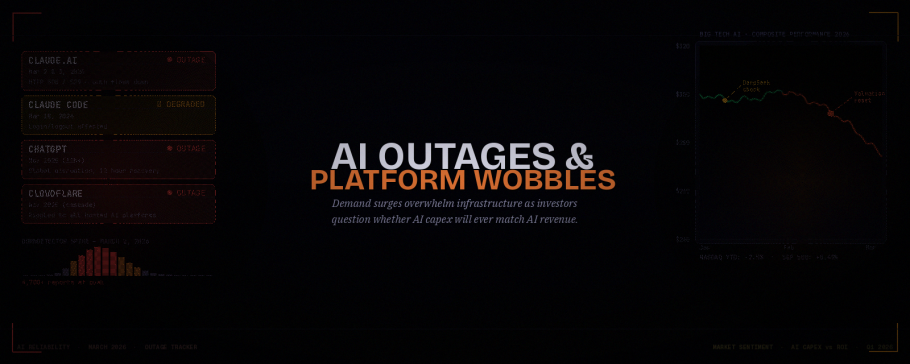
The first quarter of 2026 has exposed a critical reality for the AI industry. Rapid adoption has pushed platforms beyond their limits, triggering repeated AI outages while investors begin questioning whether massive AI spending will translate into real returns. What we are seeing is not a collapse, but a transition from hype to accountability.
Between November 2025 and March 2026, major AI platforms including ChatGPT, Claude, and Cloudflare experienced multiple disruptions. These AI outages lasted over 12 hours in some cases, affecting millions of users globally. In March alone, Claude faced several incidents, including three outages in a single day. These were not isolated failures but part of a broader pattern where infrastructure struggled to keep pace with demand.
Why AI Outages Are Increasing
Unlike traditional web applications, AI systems rely on highly complex and resource-intensive infrastructure. While cloud computing has matured over decades, AI inference introduces new challenges such as latency sensitivity, heavy compute loads, and stateful interactions.
Most AI outages are not caused by the core AI models but by supporting systems like authentication, session handling, and user interfaces. When these layers fail, users lose access even if the underlying AI remains functional. This creates a misleading perception of total system failure.
Another major factor behind AI outages is the cascading effect. When one platform goes down, users quickly move to alternatives. This sudden surge in traffic often overwhelms competing platforms, leading to secondary outages. The result is a fragile ecosystem where no single provider can fully absorb unexpected demand spikes.
The Investor Shift: AI Outages and Market Reality
At the same time, financial markets are signaling a shift in sentiment. The NASDAQ declined modestly in Q1 2026, but the deeper story lies in how investors are evaluating AI companies. Frequent AI outages and infrastructure instability are raising concerns about long-term scalability.
The era of rewarding future potential is ending. Investors now want clear evidence of profitability.
Several major software companies have seen valuation drops due to uncertainty around AI disruption. Traditional SaaS models are being challenged by AI agents that can perform tasks more efficiently, raising concerns about long-term revenue models.
The Infrastructure Gap Behind AI Outages
A key paradox has emerged. The AI industry is investing heavily in compute infrastructure, with billions allocated to data centers and model training. However, many AI outages stem from weaknesses in less visible systems such as access layers, load balancing, and control mechanisms.
In simple terms, companies are building powerful AI models but neglecting the systems that deliver them reliably to users. This imbalance is becoming increasingly costly as outages disrupt enterprise workflows and reduce trust.
Energy consumption and capital costs are also adding pressure. AI infrastructure requires significant power and cooling, making scalability more expensive.
What Businesses Should Do About AI Outages
The rise in AI outages highlights the need for smarter adoption strategies. Businesses should avoid relying on a single AI provider and instead adopt a multi-provider approach to ensure continuity.
A multi-provider AI strategy can help organizations maintain uptime even when one platform fails. It also improves flexibility and reduces operational risk.
Companies should also evaluate vendors not just on model performance but on reliability, uptime history, and infrastructure maturity.
What Comes Next for AI Platforms
The next phase of AI will focus on execution rather than expansion. The industry is shifting toward agent-based systems that can complete tasks independently instead of simply responding to prompts.
This shift offers a clearer path to monetization, especially in enterprise environments. However, reducing AI outages and improving platform stability will be critical for long-term success.
The recent wave of AI outages and market corrections marks the end of AI’s experimental phase. The technology is entering a stage where reliability, efficiency, and return on investment matter more than rapid innovation.
The AI boom is far from over, but it is becoming more disciplined. Platforms that can minimize AI outages while delivering consistent performance will define the next chapter of the industry.