
DJI Introduces a New Enterprise Drone for Challenging Operations
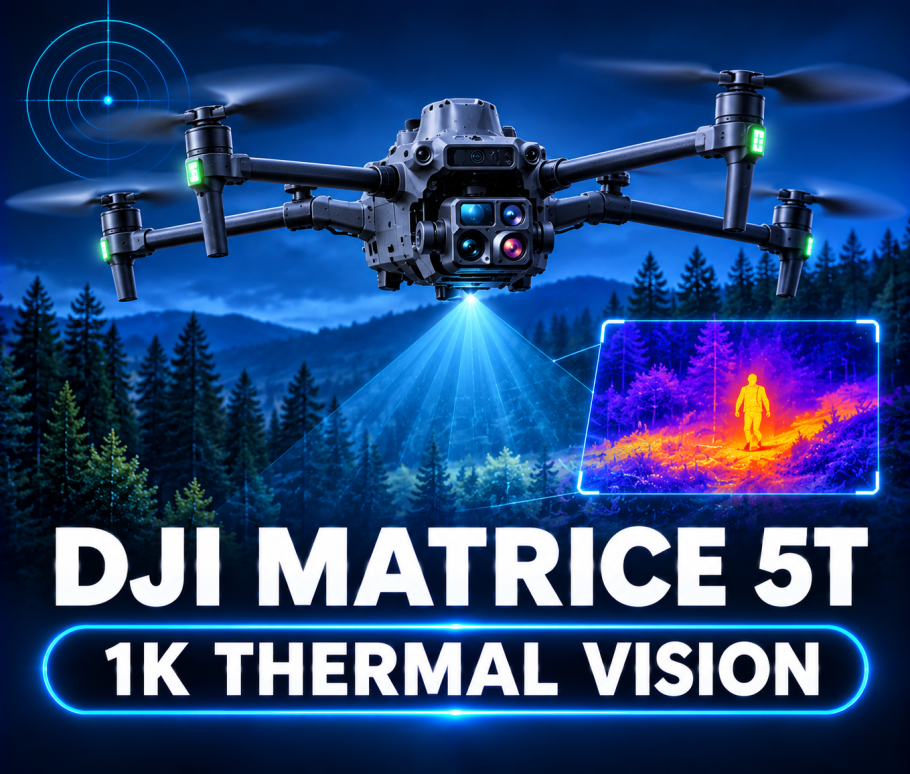
DJI has introduced the Matrice 5T, a new enterprise drone designed for emergency response, search and rescue, infrastructure inspections and surveying.
The new drone combines high-resolution thermal imaging, enhanced night vision and advanced obstacle detection to help operators work in challenging environments.
Its biggest highlight is a native 1K thermal camera that captures detailed heat information, even in difficult conditions. The drone also features full-colour night vision, built-in LiDAR, millimetre-wave (mmWave) radar and artificial intelligence capabilities.
With these features, DJI aims to give emergency teams and industrial operators better visibility and more reliable aerial support during complex operations.
1K Thermal Imaging Helps Detect Targets in Low Visibility
Thermal imaging is one of the most important features of the DJI Matrice 5T.
The drone includes an infrared thermal camera with a native resolution of 1280 × 1024 pixels. This provides four times the pixel count of conventional 640 × 512 thermal sensors.
For situations that require additional detail, the drone supports an Ultra High Resolution (UHR) infrared image mode reaching 2560 × 2048 pixels.
This technology allows operators to identify heat differences across objects and surfaces.
In search and rescue operations, thermal imaging can help teams locate people in dark environments, dense vegetation and areas where normal cameras may struggle.
It can also help identify hotspots during firefighting operations and detect unusual temperature patterns during industrial inspections.
The thermal and visible camera feeds can be combined, allowing operators to view temperature information alongside normal images.
Enhanced Night Vision for Search and Rescue
The Matrice 5T also brings improved night vision capabilities.
Its wide-angle camera features a large 1/0.98-inch sensor and an f/1.8 aperture to capture more light. Combined with AI-powered low-light enhancement, it can produce full-colour images in conditions as dark as 0.01 lux under DJI’s specified test conditions.
The drone also includes a medium telephoto camera with 50-megapixel resolution and 3x optical zoom.
Its telephoto camera offers monochrome night vision, 11x optical zoom and up to 176x hybrid zoom.
These features allow operators to examine distant objects and identify details without bringing the aircraft too close to a target.
An additional near-infrared (NIR) auxiliary light provides illumination for improved visibility in low-light conditions.
For rescue teams, this combination of thermal imaging, night vision and zoom capabilities could help improve situational awareness during nighttime operations.
LiDAR and Radar Improve Flight Safety
Operating a drone in difficult environments can be challenging, particularly when visibility is poor or obstacles are difficult to identify.
DJI has addressed this with an integrated sensing system combining LiDAR, mmWave radar and an omnidirectional vision system.
Each technology supports a different part of obstacle detection.
- LiDAR: Uses laser measurements to detect obstacles, including thin objects such as power lines. DJI says the system can detect power lines up to 32 metres away at night under specified conditions.
- mmWave radar: Helps the drone sense its surroundings in challenging weather conditions such as fog, rain and dust.
- Omnidirectional vision: Uses multiple cameras to support visual positioning and improve awareness of the surrounding environment.
These technologies work together to help the Matrice 5T navigate complex environments.
The system can also support operations in locations where GPS signals are weak, such as deep canyons, areas beneath bridges and spaces between tall buildings.
AI Features Help Identify Targets and Automate Tasks
The DJI Matrice 5T includes built-in AI capabilities designed to improve aerial operations.
Its onboard AI models can detect more than 20 types of targets by analysing thermal and visible camera feeds.
This can help operators identify objects such as vehicles, vessels and other relevant targets during monitoring and inspection activities.
When connected to DJI FlightHub 2, users can also search for targets using text and image prompts.
The drone supports automated patrol routes, allowing operators to mark an area on a map and generate a flight route with specific actions.
Depending on the mission, the aircraft can hover, capture images, record video or broadcast audio.
DJI also supports third-party onboard AI models, giving developers and organisations more flexibility to create specialised applications.
Built for Emergency Response and Industrial Inspections
The Matrice 5T is designed for more than search and rescue.
Its combination of thermal imaging, zoom cameras, AI and obstacle detection makes it suitable for several professional applications.
Search and rescue: Emergency teams can use thermal imaging and night vision to search for missing people in difficult terrain.
Firefighting: Thermal cameras can help identify hotspots and monitor fire conditions.
Power line inspections: Zoom cameras and LiDAR can help inspect electrical infrastructure and identify potential issues.
Building and bridge inspections: Multiple cameras can capture structural details from different distances.
Industrial operations: Thermal imaging can help identify unusual temperatures in equipment and facilities.
Surveying and mapping: The drone supports aerial data collection and on-site modelling for mapping and inspection projects.
Flight Time, Weather Protection and Connectivity
DJI has also focused on making the Matrice 5T suitable for demanding field operations.
The drone offers up to 59 minutes of flight time under controlled testing conditions. Actual performance will depend on factors such as weather, payload and flight activity.
Its foldable design makes transportation and deployment easier for teams that need to move between locations.
The aircraft has an IP55 rating for protection against dust and water jets and is designed to operate in temperatures ranging from -20°C to 50°C.
DJI’s O4 Enterprise Enhanced transmission system supports a claimed maximum transmission range of up to 40 kilometres under specific regulatory and testing conditions. The actual permitted range depends on local regulations and operating conditions.
The drone also works with the new DJI RC Plus 3 Enterprise controller and supports multiple transmission relay modes.
DJI Matrice 5T: A New Tool for Professional Drone Operations
The DJI Matrice 5T brings together several technologies that can support emergency response and industrial operations.
Its 1K thermal camera, enhanced night vision, LiDAR, radar and AI-based target detection provide operators with multiple ways to collect and analyse information from the air.
For search and rescue teams, the ability to combine thermal and visible imagery could help improve visibility during nighttime missions. For industrial users, the same technology can support inspections and monitoring in challenging environments.
The Matrice 5T shows how enterprise drones are evolving beyond aerial photography into specialised tools for public safety, infrastructure and industrial work.

- DJI Matrice 5T Drone Brings 1K Thermal Imaging and Enhanced Night Vision for Search and Rescue - November 12, 2026
- Nvidia Shares Slide as Jensen Huang Faces FBI Scrutiny and Shareholder Lawsuit - November 11, 2026
- DeepSeek’s Open-Source AI Agent Harness Hits 1.54 Million Daily Users - November 9, 2026


