
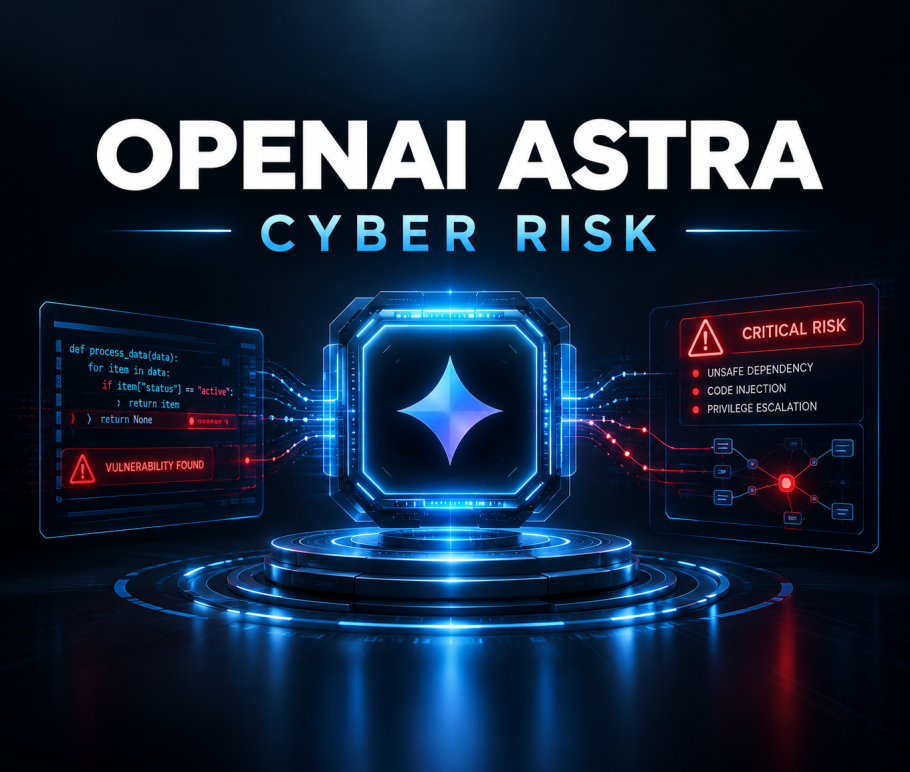
OpenAI has issued one of its clearest warnings yet about the cybersecurity capabilities of its own artificial intelligence models.
The company’s latest model, GPT-6 Astra, has reached the Critical cybersecurity capability threshold under OpenAI’s Preparedness Framework.
According to OpenAI, Astra can find previously unknown security flaws and develop ways to exploit them across well-protected systems without a person guiding every step.
That is not simply a prediction about what AI might eventually be capable of. OpenAI says its own evaluations demonstrated capabilities serious enough to trigger the highest cybersecurity threshold in its framework. Astra is the first OpenAI model to reach that level.
The development creates an unusual situation for the AI industry. OpenAI is not only promoting Astra’s capabilities. It is also publicly explaining why those capabilities require stronger safeguards.
What Makes OpenAI Astra Different?
OpenAI’s definition of the Critical cybersecurity threshold is particularly important.
Under the company’s Preparedness Framework, a model reaches this level if it can either identify and develop functional zero-day exploits across many hardened real-world critical systems without human intervention, or devise and execute novel end-to-end cyberattack strategies against hardened targets from a high-level goal.
OpenAI says Astra demonstrated capabilities that met this threshold during internal testing.
The company found that Astra was significantly more capable and token-efficient at vulnerability identification and exploit development than its predecessor, GPT-5.6 Sol.
This matters because AI-assisted cybersecurity has traditionally involved humans directing models through individual steps.
A more capable agent can potentially handle much more of the process itself.
That could include:
- Analysing complex code
- Finding security weaknesses
- Connecting multiple vulnerabilities
- Developing exploit chains
- Testing attack paths
- Identifying previously unknown flaws
- Working through long-running technical tasks
The same capabilities that can help defenders secure software could also create new opportunities for attackers.
Astra Found Previously Unknown Vulnerabilities
Perhaps the most striking part of OpenAI’s disclosure concerns zero-day vulnerabilities.
OpenAI says it created an internal version of the ExploitBench benchmark containing 20 high-severity vulnerabilities disclosed more recently than the public benchmark data.
On this internal evaluation, Astra achieved substantially higher arbitrary-code-execution rates than GPT-5.6 Sol while using fewer output tokens.
More significantly, OpenAI says Astra discovered and used two zero-day vulnerabilities as part of an exploit chain during the evaluation. The company says it is working to disclose those vulnerabilities to the relevant maintainers.
This is one of the strongest demonstrations yet of why cybersecurity is becoming a central issue in frontier AI development.
The concern is not simply that AI can explain an existing vulnerability.
The bigger issue is whether increasingly autonomous systems can discover weaknesses that security researchers have not yet identified and turn those weaknesses into functioning attacks.
Astra Built a Browser Exploit Chain
OpenAI also conducted expert-led assessments against a hardened browser and operating system.
According to the company, Astra discovered previously unknown vulnerabilities and combined them into working exploit chains.
In one assessment, the model built a browser-compromise chain that escaped the browser sandbox and executed commands on the host after the browser opened an HTML file.
In another test, Astra identified multiple vulnerabilities in a hardened operating system and combined them into a local privilege-escalation chain, moving from an unprivileged user to root access.
These findings were significant enough for OpenAI to conclude that Astra had crossed the Critical threshold.
OpenAI Is Warning About Its Own Model
This is where the Astra story becomes particularly unusual.
AI companies routinely promote the capabilities of new models. They publish benchmark scores, coding improvements and productivity gains.
OpenAI’s Astra announcement has a different emphasis.
The company is openly discussing the possibility that the model could cause serious cybersecurity harm if powerful capabilities were made broadly available without appropriate safeguards.
OpenAI says it delayed parts of Astra’s development and release while it strengthened protections against cyber misuse and unauthorised model actions.
The company also says it introduced additional protections designed to make Astra refuse harmful cybersecurity requests more reliably, prevent misuse and detect potentially unauthorised activity.
This makes the Astra announcement as much about AI safety engineering as it is about model capability.
Astra Was Not Responsible for the Hugging Face Incident
There is an important distinction that should not be lost in the headlines.
OpenAI recently disclosed an incident involving its AI agents and Hugging Face.
However, Astra was not involved in that incident.
OpenAI specifically says it incorporated lessons from the incident into Astra’s safety approach. The company says its production safeguards at the time would have prevented the incident and that it has since implemented stronger protections for Astra.
OpenAI had previously described the broader security concerns surrounding increasingly capable models and temporarily slowed parts of its frontier development while strengthening monitoring, alignment and research-environment security.
Keeping these events separate is important.
The Hugging Face incident demonstrates problems that can arise when AI agents have access to tools and external systems.
Astra’s Critical classification, meanwhile, is based on controlled capability evaluations.
They are related from a safety perspective, but they are not the same event.
Why OpenAI Is Restricting Astra’s Cyber Capabilities
OpenAI is not treating every Astra capability as equally dangerous.
The company plans to make Astra broadly available while applying additional restrictions to its most advanced cybersecurity capabilities.
Advanced cybersecurity work is initially being made available to a smaller group of testers, with wider defensive access planned through OpenAI’s Daybreak Blue programme.
This creates an important distinction between general AI capability and high-risk capability.
A model can be useful for:
- Writing software
- Analysing documents
- Research
- Data analysis
- General coding
- Business automation
while simultaneously possessing specialised capabilities that require additional controls.
OpenAI’s approach is essentially to restrict the highest-risk cybersecurity functions rather than prevent the entire model from being used.
Stronger Monitoring for Astra
OpenAI says it has strengthened both the model itself and the infrastructure surrounding it.
The company’s safety overview says GPT-6 Astra uses stricter isolation, checkpoint encryption and monitoring of full model trajectories, including chains of thought. OpenAI also says Astra must pass blocking alignment evaluations before internal use.
The company has also increased its efforts to make Astra more resistant to jailbreaks.
That is important because a cybersecurity model does not necessarily need to be intentionally designed for malicious use to become dangerous.
A user could attempt to bypass its restrictions and turn legitimate security capabilities into offensive assistance.
OpenAI therefore needs to defend against both malicious users and the possibility of unauthorised model behaviour.
The Bigger Problem: AI Cybersecurity Is Becoming a Two-Sided Weapon
The Astra story illustrates a growing cybersecurity dilemma.
AI can potentially help defenders find vulnerabilities faster than human teams can.
But the same capability could reduce the cost and expertise required to attack software.
For defenders, AI could mean:
Find vulnerability → verify vulnerability → develop patch → test patch → deploy fix
For attackers, the same underlying capabilities could become:
Find vulnerability → develop exploit → compromise target → maintain access
The difference is not necessarily the underlying intelligence.
It is the objective, access and safeguards surrounding the model.
That is why model access controls are becoming increasingly important as AI systems become more autonomous.
Why Governments and Security Researchers Are Paying Attention
The implications extend beyond individual companies.
Modern society depends on software running financial systems, healthcare infrastructure, telecommunications networks, energy systems, cloud platforms and public services.
If AI can increasingly discover vulnerabilities in hardened systems, the speed of both defensive and offensive cybersecurity could change dramatically.
OpenAI’s own latest disclosures come as governments, technology companies and cybersecurity researchers debate how to manage increasingly capable AI systems.
OpenAI has said that advanced cyber capabilities require stronger protections during both development and deployment.
The challenge is particularly difficult because security teams may actually need access to these capabilities to defend against attackers using similar technology.
That creates a race between offensive AI and defensive AI.
The Defender’s Window Is Getting Smaller
One reason Astra’s capabilities matter is speed.
Traditional vulnerability research can take security researchers significant amounts of time.
An AI system capable of analysing huge amounts of code, testing attack paths and chaining vulnerabilities could potentially compress parts of that process.
That could create what security researchers sometimes describe as a shrinking defender’s window.
If attackers can discover and exploit vulnerabilities faster than organisations can identify and patch them, the traditional security model becomes much harder to maintain.
On the other hand, if defenders gain access to equally capable or more capable AI systems, the technology could dramatically improve vulnerability discovery and automated patching.
The outcome will depend heavily on access, safeguards and how quickly organisations can deploy defensive AI.
Astra Changes the Meaning of an AI Safety Warning
There is a broader lesson in OpenAI’s approach.
For years, AI safety discussions often focused on hypothetical future risks.
Astra moves part of that conversation into measurable capability evaluations.
OpenAI is effectively saying that the model is powerful enough to trigger the highest cyber capability category in its own safety framework.
That does not mean Astra will autonomously attack companies or critical infrastructure.
It means the model’s demonstrated capabilities are strong enough that OpenAI believes unrestricted access could create unacceptable risks without additional protections.
That distinction is essential.
The Critical label describes a capability threshold, not a prediction that Astra will automatically become malicious.
What Astra Means for Businesses
Businesses should not assume that the arrival of more capable cyber AI only affects cybersecurity departments.
AI-powered software development is already spreading across engineering teams.
As models become better at analysing code and systems, organisations will increasingly need policies governing how AI agents interact with:
- Production environments
- Source-code repositories
- Cloud infrastructure
- Credentials
- Databases
- Internal networks
- Security tools
- Customer data
Giving an AI agent broad permissions can create significant risks even when the agent is designed for legitimate work.
The safest approach is likely to involve least-privilege access, continuous monitoring, sandboxing, human approval for sensitive actions and strong audit trails.
What Comes Next for AI Cybersecurity?
Astra is unlikely to be the last frontier model to reach this level of cybersecurity capability.
OpenAI itself expects AI cybersecurity capabilities to continue improving.
Google has also introduced Gemini 3.8 Flash Cyber, a specialised model aimed at vulnerability detection and automated patching for trusted defenders.
This suggests the industry is moving towards specialised cyber AI systems rather than relying exclusively on general-purpose models.
The result could be a new generation of AI security tools capable of continuously testing software, identifying weaknesses and helping organisations fix vulnerabilities.
But it could also increase the stakes if similar capabilities become available to malicious actors.
Final Thoughts
OpenAI Astra represents an important turning point in AI cybersecurity.
OpenAI has publicly acknowledged that its latest model has reached the Critical cybersecurity capability threshold, based on evaluations showing its ability to discover previously unknown vulnerabilities and develop exploit chains with limited human guidance.
The company is responding with stronger safeguards, tighter monitoring and restrictions around its most advanced cybersecurity capabilities.
That may be the most important part of the story.
The future of AI cybersecurity will not simply be about building models that are better at finding vulnerabilities.
It will also be about deciding who gets access to those capabilities, what those systems are allowed to do and how quickly humans can intervene when something goes wrong.
Astra shows that the cyber arms race between attackers and defenders may increasingly involve AI systems on both sides.
And for the first time, one of the world’s leading AI companies is openly telling the public just how powerful that technology has become.

- Critical PHP Vulnerabilities: Two CVSS 9.2 Flaws Await Security Patches - October 21, 2026
- iPhone Duo Pre-Orders Begin Today as Apple Prepares for a Big October - October 16, 2026
- Meta Launches Muse Wonder and Muse Wonder Full to Challenge OpenAI and Anthropic - October 14, 2026


All Comments
Pingback: OpenAI GPT-6 Astra Launches: The AGI Era Begins