
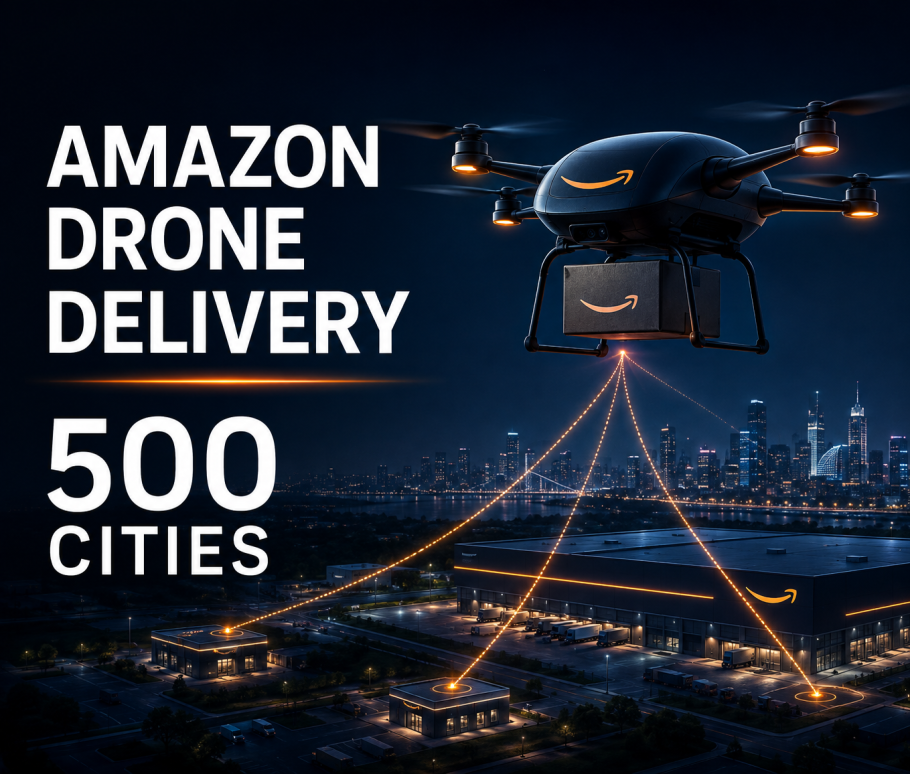
Amazon is taking its drone delivery ambitions to a much larger scale. The company is working towards expanding Amazon drone delivery to nearly 500 cities, with a target of completing around 1 million deliveries in 2026.
If achieved, the milestone would represent a major step forward for autonomous logistics and could make Amazon’s drone network one of the largest commercial drone delivery operations in the world.
The expansion combines autonomous aircraft, AI-powered routing and Amazon’s existing logistics infrastructure to create a faster way of delivering selected products to customers.
Amazon Is Scaling Drone Delivery
Amazon’s drone delivery programme, known as Amazon Prime Air, has been in development for years.
The basic idea is simple. Instead of sending a traditional delivery vehicle for smaller orders, Amazon can use an autonomous drone to transport eligible packages directly to a customer’s property.
The approach could be particularly useful for lightweight products that customers want quickly.
Nearly 500 Cities Would Be a Major Expansion
Reaching nearly 500 cities would represent a significant increase in the scale of Amazon’s drone delivery network.
Instead of treating drone delivery as a limited experiment, Amazon is increasingly looking at autonomous aircraft as another component of its wider logistics operation.
Traditional delivery vehicles would still handle most packages, but drones could take on certain deliveries where autonomous flight makes economic and operational sense.
This could create a hybrid delivery network combining:
- Delivery vans
- Warehouses
- Fulfilment centres
- Autonomous drones
- AI routing systems
- Traditional logistics infrastructure
AI Is Central to Drone Delivery
The drones themselves are only one part of the technology.
AI and automated software play an important role in determining how packages can be delivered safely and efficiently.
An autonomous delivery system needs to account for factors such as:
- Flight routes
- Weather conditions
- Package weight
- Delivery locations
- Airspace restrictions
- Battery levels
- Obstacles
- Landing areas
AI-powered routing can help systems process these variables and determine appropriate flight paths.
That makes artificial intelligence an important part of Amazon’s broader logistics strategy.
How Amazon Drone Delivery Works
The process begins when a customer places an eligible order.
Once the package is prepared, it can be transported to a location where a drone is able to take off.
The autonomous aircraft then follows a planned route to the delivery location. Advanced navigation systems help the drone avoid obstacles and maintain a safe flight path.
After reaching the destination, the drone can release the package in the designated delivery area before returning to its operating location.
The goal is to complete the entire journey without requiring a human pilot to control the aircraft.
Why Autonomous Delivery Matters
Traditional delivery networks are expensive to operate.
Vehicles require fuel or electricity, drivers and regular maintenance. They can also be affected by traffic and road conditions.
Drones operate differently.
For short-distance deliveries, autonomous aircraft could potentially travel directly between locations instead of following roads.
This could make them particularly useful for urgent deliveries and smaller packages.
However, drone delivery is not expected to replace traditional delivery vehicles completely.
Instead, it is more likely to become another layer within Amazon’s logistics network.
The 1 Million Delivery Target
Amazon’s reported goal of reaching approximately 1 million drone deliveries in 2026 is important because scale is critical to proving whether the technology can become commercially viable.
Operating a small drone programme is very different from running thousands of autonomous flights across hundreds of cities.
At scale, Amazon will need to demonstrate that its system can maintain:
- Safety
- Reliability
- Delivery accuracy
- Regulatory compliance
- Reasonable operating costs
- Customer satisfaction
Successfully reaching a million deliveries would provide valuable evidence that autonomous delivery can work beyond small pilot programmes.
Challenges Still Remain
Despite the potential benefits, large-scale drone delivery comes with significant challenges.
Regulations
Drone operators must comply with aviation regulations and local requirements.
Weather
Strong winds, heavy rain and other weather conditions can affect autonomous flight.
Safety
Drones need to operate safely around buildings, people, aircraft and other obstacles.
Infrastructure
Amazon needs suitable locations for drone operations, package preparation and charging.
Public Acceptance
Customers and communities also need to become comfortable with autonomous aircraft operating overhead.
Solving these challenges will be essential for Amazon’s long-term ambitions.
A New Chapter for Logistics
The expansion of Amazon drone delivery is part of a much bigger transformation taking place in logistics.
Companies are increasingly using AI, robotics and automation to improve warehouses and delivery networks.
Amazon already uses robots extensively inside fulfilment centres. Adding autonomous drones to the delivery side creates another opportunity to automate the movement of goods.
This could eventually lead to logistics networks where software coordinates warehouses, robots, vehicles and drones as a single system.
What It Means for Customers
For customers, the biggest potential benefit is speed.
Drone delivery could make it possible to receive certain products much faster, particularly when the package only needs to travel a short distance.
It could also provide another delivery option for locations where traditional delivery is slower or more expensive.
The technology will initially remain limited to eligible products and locations, but expansion could gradually make autonomous delivery more common.
Final Thoughts
Amazon’s plan to expand Amazon drone delivery to nearly 500 cities and target around 1 million deliveries in 2026 shows how quickly autonomous logistics is moving from experimentation toward large-scale deployment.
The combination of AI-powered routing, autonomous flight and Amazon’s massive logistics infrastructure could fundamentally change how certain packages reach customers.
The bigger question is no longer whether drones can deliver packages.
It is whether companies can operate autonomous delivery networks safely, efficiently and economically at city scale.
If Amazon reaches its ambitious target, the answer could become much clearer.

- Amazon Drone Delivery to Reach Nearly 500 Cities - August 20, 2026
- Alibaba AI Models Hit 3 Billion Downloads, Overtaking Meta and Google - August 17, 2026
- Google Pixel 11 Unveiled With Gemini at the Centre of the AI Phone War - August 14, 2026


